Blimey, this is turning into being quite a tome. It looks like there's going to be two parts to this story - first, some of the key trends that set the context for the discussion, and second a selection of the innovation activities that we have been working on recently to ensure we accomodate these trends.
During the conference mentioned in the previous post I only got to talk to about a few of these ideas, but I wanted to document them while fresh. It's worth bearing in mind that everyone at Nokia will have a different take on this universally discussed, but rarely adequately defined theme of innovation - since there is an assumption that innovation is owned by everyone. In terms of what innovation is, this was a topic of the night before, and the Editor of the Economist's favourite definition, courtesy of Goldman Sachs, was "fresh thinking that creates value". That works for me, since it reminds us that new ideas alone are nice but irrelevant if they don't have an impact.
So, to the trends. As a company we are grounded in fundamental trends. Nokia is full of fact-loving engineers, and there needs to be data and evidence for what we do. We're unlikely to jump like a jitter bug to the latest shiny thing. That means that sometimes we may be seen as cautious, and may not get it right first time, but when we do it, we know we're doing it for the long haul. (N-Gage comes to mind). When I joined Nokia in 2003 in the delightfully named Insight & Foresight group, one of my tasks was to write the macro economic section of the annual Nokia WorldMap of the top trends in the converging digital industry. This was organized in terms of consumer, business, technology, macro trends, and some overall disruptions, and had about 50 trends that were the summary of a year's worth of analysis of the team. These are updated every year, and I picked a selection that I found most compelling to set the tone: the net generation, the search for authenticity, the information wake, harnessing collective intelligence, mass customization, consumerization of the enterprise (aka Enterprise2.0) and leapfrog innovation. So, now to provide more meat on the bones:
The demographic shadow of the baby boom generation is the net generation, today's 14-30 yr olds that are globally the most influential demographic, accounting for 25-40% of populations (highest in India and Pakistan) and something like 80% of consumer tech purchases, since they advise their parents (data from Don Tapscott's Net Generation project). They live in a polychromatic world (one of Joi Ito's favourite phrases) - vibrant, instant, colourful and multichannel, sharing their lives, often in breath-taking technicolour intimacy with the world, but more often just the people and communities who matter to them. These are people used to being exposed to 3000 brands a day, but not letting them stick. They filter out noise and froth, as if reared subconciously on the Cluetrain. They're the teflon generation, which drives traditional marketers crazy. They're used to being intimate with each other, and ironically, can also be intimate with brands, in particular those that demonstrate authenticity. Authenticity here can be defined as tranparency coupled with high performance, in areas such as environmental sustainability, provenance, employee relations and conversations, not marketing. It means cutting out the spin and the intermediaries between people and the things they want to connect to. Relationships - undiluted. Authenticity means people and companies articulate and share their own unique values, they don't just follow fads. And perhaps more than anything it means mountains of data. There is a high bandwidth for information, and the filters are expected to be client-side. The more blogs the better – not just from the CEO (unless he or she is interesting in their own right), but from the product managers who can talk with loving micro detail about obscure features. The data doesn’t need to be packaged – the rawer the better, otherwise it seems patronizing. Hence the carbon footprint of a packet of crisps – let the people decide. Data about the provenance of things and people is everywhere nowadays, and the smart companies are collecting and analysing it to create better services. Last.FM, Amazon and NefFlix filtering that learns your taste and suggests new things being a simple example. Up til now, these smart recommendation engines have been constrained by the paucity of useful, unique data sets that help the services know that your favourite thing and mine are one and the same. Similarly singers and their products, with the notable exception of a number of Stock, Aitken and Waterman clones from the 80s, are generally unique and different. Meaning can be layered on top, and smart algorithms do their bit. The most obvious (and bankable) recommendation engine to date is of course Google, that uses that wholly unique asset, the URL.
So, here I believe lies the potential of the mobile web – opening up new datasets for analysis and recommendation, with monetary values far in advance of the pennies that vendors pay for the click of a potentially interested surfer. If Amazon can use its smarts to get me to a buy a book based on my behaviour, why not allow someone to recommend what car I should be driving based on an analysis of my actual life, not just the slice of me inferred by my purchasing habits on one book-orientated website. The beauty of the mobile device is that it's not only smart, but connected. According to a China Mobile study, 91% of owners keep within 1 metre of them 24/7. Unlike traditional surfing through the web, this mobile device is moving with you through the "three dimensional" (i.e. real) world, leaving an information wake. The mobile device has the ability to capture and deliver a vast number of different data streams, such as location, who are your real friends (ie those people in your mobile phonebook, not the pale imitations found on social networking services), who do you call the most, and even in future, what you buy, what you eat or how you exercise. This data is created by the user and as such is – or should be - owned by them - getting them to part with it in order to receive useful and services is one of the primary innovation and creativity challenges of our generation. So far, I don’t see clarity in the industry on this and it’s dangerous. We allow Microsoft to create the tools that allow us to write novels, but do not expect them to claim ownership. Similarly, we hire the phone companies for the reason of connecting us with people we chose to connect to. If in doing that, we create a digital trail of commercial value, it would be folly not to assume that most of this value resides with its creator.
Smart companies will figure out how to get the customer to let them tap into these data streams, and use them to generate collective intelligence about what the customers want, often before they even know they want it. Automating data collection and feedback on products will be a breakthrough in terms of productivity, and here again the mobile has the potential to be part of this story. I often wonder why on earth the operators don't actually do something useful with their aggregate view of mobile users. How hard would it be to deliver very powerful real time traffic reports, just based on observing the anonymized progress of the swarms of phone-toting commuters?
Product innovation will be a lot easier when every product has an online service component providing usage information to improve the experience. Who would have expected that rowing machines - a product if ever there was one - would be turned into a social-networking compliant "rowing experience" by bundling net-connected service with the product, allowing you to race against other strangers and friends around the world. With products that can now talk back and among each other, it's a lot easier to have an aggregate view of what is actually happening around your customer's world, and how to fill the gaps. However, this is happening everywhere, with a surfeit of products and services clamouring for the every drop of customer attention.
The natural response to this is to dive into a niche, ever closer to the customer. And it is here that mass customization starts to become both necessary and ubiquitous. With the provision of a service layer on top, even the most anodyne, commodtized product can be differentiated. Telco companies have been trying for years to inject higher level valuable services over the creeping commoditization of connecting bits that is happening to their communications services. Whether its Nike's online service for creating a unique pair of shoes, or the 3D printer that can create a product while the customer waits, people are expecting their products in any colour they like, including black.
However, this supply chain flexibility does not come cheap, and will be another factor that puts pressure on profit margins, in addition to declining entry barriers and commoditization. As such corporate managers suffer quarterly performance anxiety, and face intense pressure to control every moving thing, and cut costs to the quick. Letting go of control and allowing innovation to meander throughout an organization, unencumbered by ROI concerns, must be very hard for people in this position. However, this is exactly what needs to happen in some cases, as in any event, corporates are losing control of their employees. Consumerization and Enterprise2.0 means, in short, Web2.0 principles and processes coming to the workplace, and the resultant empowerment of the edge (in this case employee rather than employer). Employers are learning they are often only coming second (or third or fourth) in the prioirity of their employees. No longer poorly designed collaboration, knowledge management and communication services stand up to scrutiny - employees now have more advanced collaboration technologies in their personal lives, and will expect to use them in the workplace.
Employers letting go of control of their employees is just one element of Enterprise2.0, the changing shape of the corporation being another. Why do we need marketing if a product sells itself and manages the customer support through its own Satisfaction-like community? The only interaction a customer may want with a company is to speak directly to the product manager themselves. As mobiles become more contextually keys for advertising, how will companies be able to accomodate the switch from mass, non specific advertising, to micro, personalized conversations with an audience of one. Finally, not only with corporate hierarchies change, but geographies too. Micro-multinationals mean that companies can locate anywhere, and take advantage of different cost structures and innovation clusters to become worldclass on a shoestring budget. In this vein, leapfrogging occurs - innovations happen first in the developing world as they are driven by creativity inducing constraints. Hence the best place to get cataracts done is in India, and most advanced mobile payments services in Africa.
So, here are a handful of the key trends that I feel are most important in shaping our competitive space - some more relevant than others, and some still debatable. Anyway, next post I'll take a look at some of our innovation activities that we've been putting in place to meet the challenges posed by these trends head on.
Friday, October 19, 2007
Nokia's innovation story, Part 1 - key trends


Economist Conferences: how they all should be
My colleague, fellow brit, sailing enthusiast and co-conspirator on some dangerously interesting ideas, John Clarke, is the CIO of Nokia. Unfortunately for him his role means he has real customers to keep happy, vendors to whip, and crises to solve.
Fortunately for me, a perfect work storm hit him this week, and he had to grudgingly hand over to me his attendance at the tremendously interesting Economist 6th Annual Innovation Awards Ceremony and Summit. As a peon normally labouring several layers under the public radar screen, I normally just hawk my wares to an internal audience where I do only limited damage. Hence, when handed this opportunity I was a little nervous. The idea of sitting up on stage with bulging-brained business editor of the Economist, Tom Standage, the CTO of BT and a VP at P&G and talking to a press-strewn room of senior execs about Nokia's innovation story was a little disconcerting.
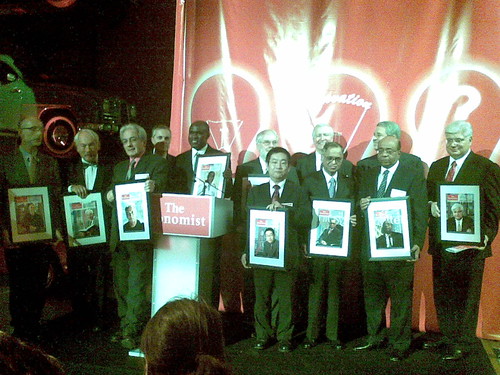
But actually things went rather well, I think, and my next blog post outlines roughly what I would have said, had I not been answering questions the whole time. But first, it's worth describing the context of this uniquely colourful and interesting meeting. The night before the Summit is an Awards Ceremony at the Science Museum. As a Speaker, I was invited, albeit last minute, and brought along my bemused friend Daryl (who I had planned to meet up with). He had great fun in trying to embarass me in this esteemed company, and fracture the delicate artiface of grownup professionalism that I wear rather awkwardly. However, as the champagne flowed, we started to get into our stride - we buttonholed famous Peruvian economist Hernando do Soto for 15 minutes. He's one of my heroes (I think I may have actually used that phrase to him) - his work on identifying the importance of property rights in developing countries has had a profound impact in his lifetime, and as such he now consults to 21 heads of State. His think tank is described by the Economist as one of the two most influetial in the world. We were seated at the table of Economist editor John Micklethwait, and inches away from the procession of Nobel laureats, billionaires and brainiacs that were honored in this year's awards. My shoulders were brushed by some pretty impressive midriffs: scientists who developed a way to do AIDS tests really quickly, the Chairman of India's outsourcing marvel Infosys, the founder and CEO of RIM (garage tinkerer to hero in 10 years); pioneers in LEDs; the guys who invented GMR (memory storage) which made my iPod possible, and finally an African telco entrepreneur who just sold his corruption-free business for $3.4bn. Phew.
At the end of last night it was obvious that I'd already had more than my money's worth and was starting to enjoy myself. The event was expertly managed, with delicious food, crisp timing, inspiring surroundings and ridiculously bright and successful people at every turn. Encouraging words from Tom Standage put me at my ease, and all I had to do now was think through what was the Nokia innovation story that I wanted to tell. I soon realized that actually, we've got a lot to say, the question was picking the right bits. Whether I did or not, you decide. That's the topic of the next post.
Saturday, October 06, 2007
I want to build a tool for hate
I want to build a tool that allows spittle-fuelled invectives, deep dark howling rants and purple prose that takes your breath away. But relax, this isn't a story of bad hatred - of people, politics or puppies. No this is about good hate. Good hate is hatred of bad things. Crime, corruption, inefficiency, lawlessness, thuggery, treachoury, cantankerousness and deeply bad service.
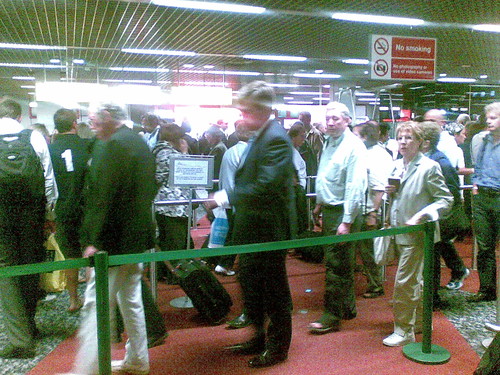
What started this train of thought was a specific incident last week as I ate the gruel of tatty "service" that the beleaguered Heathrow airport serves up cold. Arriving late night in Terminal 4, there was a long queue of several hundred people waiting for passport control, and a separate queue for the iris scanning machine. Now, having had my iris scanned I went up to this shorter line, pleased with the prospect of a sharp exit. After about 5 minutes of waiting around and realizing that the line wasn't getting any shorter, it was clear that the system wasn't letting people through. An official overseeing the mess from the command center then saunters up and says, Nope, the machine's not working, so we'd better go back to the line. By this time, a few other hundred people have arrived, so we stumble back, with more of our lives wasted. So bad enough that the machine wasn't working (happens on about 1 out of 3 times I've tried these machines) but nobody could be bothered to even put up a sign saying sorry, don't waste your time. Just one example, there are countless more, at that airport alone.
My annoyance at the appalling state of our airport is mashed with embarrassment that any foreigners should be exposed to this as the first thing they see, liberally sprinkled with utter helplessness - both due to not being able to do anything about it but also because of my inability to vent my frustration in a satisfactory way. Of course there was huffing and puffing by my co-victims in the queue but we're all in the same boat.
I should shrug it off, toughen up. God knows, as a Londoner I have ample opportunity to feel frustrated with what goes by the name of our public transport service. I felt like jumping up and down and screaming NO, THIS IS COMPLETELY SHIT!! However it's been about 30 years since my last public tantrum, and civil society impedes a direct 1-1 relationship between the rages in my head and my vocal chords.
But, let's leave aside this dark story - the reverse, happier side is also true. I also want to create a tool for Love. Heaping large amounts of love on a person should be easier than it is today. I want to say that I love that building, that organization, that hero that I've never met.
And to an extent the Web does give me a voice to do exactly that. However, it is not really well designed to deal with real things - it prefers to deal with URLs. It organizes by [http followed by indecipherable code] rather than [that which we commonly refer to as...]. Having a naming convention built around real things and real places would be really helpful. Where do I go if I want to complain about Heathrow? Well, if I wanted to complain about a restaurant inside Heathrow I might be lucky, and find something on Yell or Timeout or Squaremeal or LondonEating or wherever. But what about Heathrow itself? This creaky, wheezing behemoth is a major part of our lives, but its online presence is an anodyne, sterilized boilerplate, which clearly has no intention to allow us to peak behind the curtain to the conversations that real people are having with each other about this infernal place, and attempting to have with Heathrow.
What I think we need is a place on the web that can be the hub of discussions around an airport, a brand, a government, a city, a product or, well, just about anything, whether or not the owner in charge likes the idea. Of course these conversations are happening in a fragmented way today, and Google is doing a good job at knitting these together for those who search for them, but this is ad hoc. Each of us enter queries differently, and the results that Google delivers are generally between them and us, with few search terms on brand names delivering the genuine voice of the people rather than the PR department. However, there's no denying - it would be nice to have a global directory of things that we all use and refer to.
Happily, am seeing some small steps in this direction. People-powered customer service directories is not something I knew existed until recently, and now there are two. The founders of Silicon Valley startup Satisfaction were over in London last week to speak at the Future of Web Apps conference, and I've just heard about another startup from South Africa called HelloPeter, which has been doing the same kind of thing for a while. I had a good chat with one of the founders of Satisfaction, Lane Becker, who was also one of the founders of the rather wonderful Adaptive Path. I was struck with the simple proposition of their site - they're going to help your customers have conversations about your brands, so you might as well join in. This level of transparency requires a company to feel good about their product, and their customers, and some impressive, customer-focused companies such as Timbuk2 are already using it to have even more open conversations with their customers.
Well, you can guess the rest. Reared on a Hollywood addiction to happy endings, I'm hoping that need for hate will disappear. So I created a channel for Heathrow at Satisfaction (http://getsatisfaction.com/heathrow) noted my problem, and now wait, patiently and ever optimistic (like those in the line for passport control) that Heathrow - and bad services around the world - will start to listen. And maybe even respond.
Thursday, September 27, 2007
Speaker Series: Sean Moffitt on Wiki Brands
I met Sean Moffit, the founder of Canadian word of mouth marketing company Agent Wildfire, a few months ago at one of Don Tapscott's seminars and he gave a convincing talk on the need for brands to be more defined by customer interactions - hence the name Wiki Brands. He came over to Nokia House a few days ago and delivered a well-received presentation that delivered a blizzard of case studies and statistics in a compelling way that left most people with a clear picture of some of the major changes happening in branding today.
We also had a few of Nokia's own word of mouth experts in the room (we've got a fairly active programme) who shared what they'd been up to.
Monday, September 10, 2007
Your favourite 2.0 pundits?
Quite a few people are asking me for recommendations about good social networking and 2.0-type thinkers and speakers, not necessarily just from the mobile space. Most of the requests are UK/Europe, so probably makes sense to start there.
Have you heard someone you think is good recently that you'd like to recommend? Or - no time for modesty - are you yourself interested to be "on the circuit" and willing and able to share your strong opinions about matters 2.0, social networking and / or enterprise 2.0? Would be great to hear from you. Either leave a comment or ping me on stephen dot johnston at nokia dot com.
Wednesday, August 29, 2007
Pablos comes and stirs things up
"Pablos" is quite a well-known hacker, security expert and futurist, who I saw give a great presentation at the DLD Conference earlier this year, so invited him to come to Helsinki and talk to Nokia.
He's worked on numerous cool projects, such as OQO and the hackerbot - which drives up to people with open wifi and shows them their passwords. We had a roundtable brainstorming with him afterwords and my key takeaway was the many overlaps that exist between the murky world of hacking and the gleaming prize of innovation. As we start to launch our new internet services, we're going to need to learn how to be fuzzier, murkier and more willing to embrace the hacker ethos that Pablos and his uni-named friends embody.
Sunday, August 12, 2007
Enterprise2.0 - what does it mean for mobile?

In the past few weeks I’ve been having a number of interesting conversations about “Enterprise2.0”, what it means for mobility in general and for Nokia in particular. Despite a handful of productive and insightful commentators, it’s rather an anemic oeuvre compared to its Big Brother Web2.0 with very little written on the mobile aspects – as we could probably expect, given its U.S. origins. So, I’ve had some chats with some reliably smart folk such as Marc Orchant and Ajit Jaokar (who has also started musing on the topic), done some exhaustive research (yes, dear reader, minutes not seconds), and am liking what I see. It seems that many of the defining elements of Enterprise2.0 are a natural fit to the mobile space, in particular the possibility to capture and more easily transmit new kinds of data (for example putting location, context and communication history as an integral part of E2.0 services), the modular architecture of web syndication (RSS and user-defined filters work well on mobile) and, not least, the opportunities for the mobile to replace the PC, in particular for small businesses and / or emerging markets.
All is not rosy however. The mobile industry faces major obstacles in being part of this interesting arena, for example i) fragmented mobile operating systems, most of which are not built from the ground up to be web native ii) the default PC-centric approach towards enterprise2.0 applications (big screen, keyboard and sophisticated browser) and iii) despite some signs to the contrary, still slooooow progress by the mobile operators to get out of the way of innovation and introduce transparent pricing and proper flat-rate tariffs.
So I’d propose that the mobile industry should stop scrapping over who gets which share of an ever dwindling consumer pie and instead target the bigger prize – helping companies go 2.0. And that means a new, open and collaborative approach with a much wider range of partners than the mobile industry normally works with, so that we can figure out how to bake mobility into Enteprise 2.0 from the start.
Defining moments – people, not process
Definitions are often tricky, but in the case of Enterprise2.0, it shouldn't be hard - since it is really just Web2.0 goes corporate – from the frat-room to the boardroom. Harvard’s Andrew McAfee, one of those most active in the paternity battle for this new babe, defines it as “the use of emergent social software platforms within companies, or between companies and their partners or customers”. A more expansive view would also take in the people dimension, such as this summary from a recent Enterprise2.0 conference: "a radical change in the way businesses operate and is as much about the people, the culture and the processes as it is about the technology, tools and platforms.” So either way, this is a story of socializing the enterprise (not a word that comfortably fits in most capitalist dictionaries). But if this approach puts people front and centre in companies, rather than inflexible processs and acronyms, I’m all in favour.
McAfee provides a helpful acronmyn (SLATES) which highlights key 2.0 characteristics that will generally be found in these solutions: search, links, authoring, tags, extensions, signals. More explanations in his original paper. Social software is a key building block for Enterprise2.0, and it is starting to attract IT managers’ attention. Gartner’s July 2007 research paper, “The Emerging Enterprise Social Software Marketplace” predicts a compound annual revenue growth for social software of 41.7% through 2011 (from $120m last year to $700m in 2011). They say it’s now moving beyond the traditional blogs and wikis to include “social software platforms, bookmarking, communities of practice, discussion forums, expertise location and information feeds”.
The timing is right for this discussion, as Enteprise2.0 is rapidly going mainstream. McKinsey found three quarters of executives planning to increase investment on these kind of collaborative tools. A Forrester survey of 119 CIOs found 89% “had adopted at least one of six prominent Web 2.0 tools - blogs, wikis, podcasts, RSS, social networking, and content tagging - and a remarkable 35% said they were already using all six of the tools.”
So, to the mobile angle. Mobile has generally been the ugly duckling of the 2.0 world, but things are changing. Just when we were finally seeing mobile browsers tackle full Ajax-y web pages well and start to convince people thinking that the mobile web and the real web aren’t really that different, along came rich browsing applications that raised the bar still higher for our already fiendishly creative geeks. The Big Browser paradigm is inimical to mobile, and if we try and squeeze it into little screens it will end in tears. One example, while reading a NYTimes piece on how your friends can make you fat, I noticed that you’re able to double-click on any word in the story and pull up a definition of it, without that word being in hypertext. That is a fairly new concept to me, and if it becomes widely adopted, could pose yet another challenge for mobile, as today’s mobile browser user experience do not seem to allow such doubleclicks. However, we all know the world is going mobile. The interesting question is whether the mobile element will be an afterthought, tacked on with limited functionality, or will be a fundamental part of the experience from the beginning. So I looked back at the Web2.0 principles Tim O'Reilly wrote in 2005 that seem to have weathered the discussion well and have now become part of the furniture. Most of them as we can see are relevant to the enterprise space, but what do they mean for mobile?
1. The Web as a platform
On the consumer side, the Web is now clearly the global platform for developers, entrepreneurs and individuals. Consumer-focused startups now need a fraction of the money they used to in order to get up and running, and scale with relative ease. MySpace, Bebo and Facebook have brought social networking to the masses – people who neither know nor care that such a term exists. That this trend is going corporate is one of the tenets of Enterprise2.0. Consumerization of IT is afoot, and consumer-focused tools (IM, VOIP and social networks) are appearing either neat (19,337 Microsofties on Facebook) or diluted to taste (LinkedIn and other less colourful offerings). However, the fuzzy, beta-nature of many of these services mean they’re not suited for business critical functions such as the software that runs our big manufacturing plants. Also, it is still hard for web-based startups to break into the big corporate accounts – you can’t yet code a business lunch or round of golf in Ajax. Supporting this, the Forrester survey found that 71% of companies would prefer “tools to be offered by a major incumbent vendor like Microsoft or IBM [rather than] smaller specialist firms like Socialtext, NewsGator, MindTouch, and others”. So, the web is not yet as advanced for enterprise offerings as for the consumer side.
As for the mobile industry, let’s be honest – we still have a way to go. Fragmented operating systems, screen sizes, resolutions and capabilities frustrate development efforts, few entrepreneurs are making real money out of the mobile internet or seeing large scale service adoption, and few people would chose their operator (or handset maker? let’s see) to provide their social network rather than their fresh-faced, agile web innovator. However, let’s remember that the mobile is much more recent arrival than the PC, and there are uniquely challenging constraints regarding form factor, UI and battery life etc. It is worth mentioning here that Nokia has been focusing like a laser beam on this topic in recent months – it has dominated recent corporate strategy dicussions and is now at the core of our recent reorg and new company structure. Our CEO has made “we’re an internet company” pronouncements whenever he’s been offered a microphone; Symbian is taking great strides in becoming more developer and web-friendly, and our browser is one of the industry’s best kept secrets (and incidentally, shares most of its code with the iPhone). We’re also starting to deliver some rather funky new apps, including a mobile web server, real-world browsing and of course the web tablet and open-source Linux platform (Maemo). Advert over – but worth saying, and no doubt other mobile players are being active here. As an industry however, we’re still playing catchup.
2. Harnessing collective intelligence
Amazon is often held up as the first example of a service provider that lets users benefit from collective intelligence through their collaborative filtering engine. So, why would this not also work in areas other than books? For example, "intelligent" CRM software could scan the salesperson's customer responses, and suggests appropriate product offerings based on large numbers of other interactions, potentially also outside the company. (Actually, maybe it does already, it’s been a while since I worked in the industry). Most sales people are inherently mobile, and providing lightweight usable tools that expose this collective intelligence at the right time and in the right context, could be a very valuable offering to mobile users.
Wikis are great at capturing user-created intelligence and are rapidly becoming mainstream in the enterprise space, but if you’ve ever tried using one of today’s wikis from your mobile, you’ll appreciate the inherent problems here. Socialtext have been making moves in this regard, but here is a standard chicken-and-egg problem – limited demand resulting in limited development time, begetting limited offerings. UI and synchronization are the key issues to solve. As noted above, services requring smart and big browsers face an uphill struggle on the mobile. Today’s wikis often suggest side-by-side version control review, and require a big screen to see the differences. Synchronization is a key conceptual challenge with mobile, since they generally are not always on. Wikis rely on having one version of the truth – two people making changes to the same item when offline then syncing later makes would vex Schrödinger himself.
Today project managers in Nokia that I work with will generally just create an empty wiki space as they start a new project. This example is being played out across the corporate landscape, and could well disrupt collaboration applications that are built on the assumption that the designers – cut off from the action – know what’s right for each project. Here Nokia’s interests are well aligned with the wiki companies and web services companies in general – do away with the need for a PC and keep the smarts in the cloud. Once bottom up “architectures of participation” are in place, powerful learnings can then be harnessed - enterprise-focused social networking tools (Ryze, Tribe, LinkedIn) are able to unearth links, activities and dependencies around the organization which traditional hierarchies and organizational structures miss.
There are plenty of ways that mobiles could be used as both in-the-field data gatherers, providing relelvant context, or being the mobile manager’s tool of choice for viewing and interacting with the wisdom of the crowds who have gone before.
3. Data is the next Intel inside
A key element of anything with a 2.0–suffix is about shift of control and content creation to the edges. In most companies, ours included, there is a lot of valuable data being created by our employees and customers that is currently not captured or utilized. As the locus of value moves from product to service, capturing and understanding these conversations is becoming a key requirement. These customers and employees at the edge now have the tools, techniques and – significantly – expectations about their ability to make change happen. Wikis and blogs are now full-to-bursting with valuable first-person thoughts, reflections and data - some unstructured, others in an array of formats. This data is now the beating heart of today's enterprise, and often a unique repository of insights from the key experts in the company. Few senior managers will fully appreciate this resource because it has arrived via the back door.
Nokia's own efforts at promoting wikis and blogs internally continue and are now reaching mainstream. There is still however plenty more scope for their use in the harder-to-reach, business critical areas of the business, such as the sales teams and factory management. When you’re making 300m+ phones a year, the fuzziness inherent in wikis needs to be selectively applied. Also there is room for more innovation on top of the many tools that are available. TiddlyWiki (recently purchased by BT) integrates IP-communication plug-ins to the wiki framework, thereby allowing in-house IT executives to hack together innovative IP & mobile communication experiences, without needing long requirements lists, lead times, operator involvement or large amounts of money. They used to burn people at the stake for such heresy.
I expect to see companies doing more with wikis and blogs, using them for key product and customer data, with relevant user-level access controls if necessary. At Nokia we are using the open source MediaWiki engine used for a Nokia Infopedia, to make it easy for people to find and then use the key data about our products, solutions, organizational change initiatives, pricing, strategies, marketing initiatives etc. Often overlooked is the change of pace that needs to take place when the early adopter tools move mainstream - today's wikis are still too complicated and hard to use, so a top-down campaign to encourage wiki use will fail without adequate thought and resources being given to training and education, as well as experimenting with new simple UI developments such as drag and drop and other concepts that people are already familiar with. Salesforce.com's AppExchange and Jive Software's clearspace are interesting in this regard. We need to get the balance right between innovation and communication in order to bring all employees along this path.
Customer conversations that happen around our products represent the possibility to collect insanely valuable data, and engage in genuine conversations with the people who buy our stuff. Currently, as a product company, we don’t yet do this on a large scale – just a few pilot initiatives and ad hoc discussions around individuals’ blogs. Contrast this to Google - every second their search engine receives primary user data, about terms that matter to them, and the effect of every change that Google makes to its site can be callibrated immediately, and they can get a sense of the pulse of the world in real time.
Moving from the source of data to the type of data - we are going to be seeing next generation web services start to be built for a three dimensional world, and one in which context is king. This will massively increase the number and type of data-sources available as inputs in the creation of web services. The scope and type of services that can be built using this data are difficult to imagine, because so much of the web today is in two dimensions - when you are reading your email client, the email sevice provider does not know if you are in Sydney or Sidcup.
Data can be defined broadly here - from active, user generated tags (modular, and easy to submit, so perfect for mobiles) to specific data, captured in the background such as usage and communication metadata. How easy is it for users of our devices to access their own data - where they've been, who they've talked to, what applications they've used the most etc? In short, not easy at all, yet.
Nick Carr highlights a critical piece of the puzzle suggesting that Enterprise2.0 may have a better chance than other new fangled technologies – they make life easier not harder. In particular, the system gets smarter as people use it normally. “Knowledge is captured, in other words, as it's created, without requiring any additional work”. The classic consumer examples here are Last.fm’s music recognition and Amazon’s collaborative filtering – both services allow your profile to become smarter and more helpful to you over time, if you give it access to what you do. So the incentive to use it increases. A fascinating question to me is to what extent can relevant data be automatically captured from the mobile device that you carry with you 24hrs a day, and itself be an input to new Enterprise2.0 applications.
It is the different types of data available to creative entrepreneurs that should make the mobile industry sit up and take notice. Location information is one key ingredient that is trapped and lying dormant for want of a ha’penny of innovation. An entrepreneur I spoke to recently said he would have been charged €0.15 for each call that his application made to the operator to get a location fix from their cell ID. What a wasted opportunity to add value. He is obviously now routing round the roadblock and using GPS or consumer-created information database. Location is just one piece of data, but there are many others on the phone – which companies you call the most, who your friends are, who was in Bluetooth range over the past few days. With careful management and consumer-friendly usage, such data could lead to new technicolour applications and services that will make today’s Enterprise and Web2.0 services look black-and-white.
4. Perpetual beta
The mobile industry has unwittingly delivered plenty of betas in the past (WAP, MMS…), but they weren’t marketed as such. Instead of failures, they might have been seen as tentative first steps. But then it’d have been hard to justify charging consumers so much for them. Few in our industry seem to have recognized that the value of rich, direct feedback from users can far outweigh the minimal revenues that are captured by overpriced and underwhelming services. This requires a change in attitude, and a more open conversation with customers. This will in turn require changes in our transparency and "corporate voice". It is not about shipping and forgetting, but about partnering with customers who are trying to maximize the value of their investments. The Web2.0 software company 37signals does this well - a product-focused blog keeps news of almost-daily upgrades flowing and rapid and personal customer support for paying customers results in a high comfort level, and willingness to engage.
The beta mindset is coming to mobile: recent examples include Orange’s coding camp in August for developers in San Francisco (which perhaps included some marketing element to boost the launch of their Bubbletop web/widget service) and Vodafone R&D labs’ Betavine which aims to “encourage collaboration in the area of mobile and internet communications”. At Nokia, we’ve launched Nokia BetaLabs for the public and internally we have a service called AlphaLabs which now has about 75 applications and services for employees to test and provide feedback on. However, I see most of these activities as table stakes – we’re not really raising the bar of innovation beyond what is happening on the web, and in any event, it’s often far more challenging to be a beta tester on mobile – installation is harder (though our PC suite product is now actually pretty usable), user numbers are lower so there’s less feedback, and there’s always a danger that we’ll alienate (and bankrupt) our users who download data intensive applications without a decent data plan. Another challenge here is the current community forum experience on mobiles – it’s fairly poor, and most examples are just web-based forums squeezed to a small screen.
The more interesting issues relate to the topics that today’s beta aspects can’t handle well, and here mobile connectivity makes continuous feedback possible, and smart contextual awareness means that feedback can more easily be provided automatically. As mobile platforms mature and become more integrated with the web, expect to see greater use of the mobile as both a direct channel for feedback on mobile services, and a feedback tool integrated with existing web services (an example could be the integration of music recommendation service Last.fm with the music player on the phone).
5. Lightweight Programming Models
New open web standards are being deployed across the enteprise in particular to enable richer user experiences (e.g. AJAX), mashups (XML) and syndication of content (RSS). These allow individuals to create personalized feeds based on information that is important to them, but may not have a critical mass in terms of numbers of users, to get a tailored solution built for them. Related to this is the concept of "hackability" - how to make sure that the individuals (either employees or the customers-themselves) have enough control over the system to create their "own-label" solutions, and then, ideally share with others and improve for the benefit of the whole ecosystem. The concept of hackability is anathema to the mobile industry, and there are some pretty solid reasons for this: sensitive personal data and the ease of running up large bills being two obvious places to start. So clearly there needs to be some thought given to what is opened up and what is locked down. I’ve heard a number of people say that J2ME is not that interesting as you can’t do very much with it – such as accessing the calling and connectivity features. However, I’m a business guy not a technologist, so I can’t add much here, apart from to say that the mobile industry doesn’t have the luxury to sit on its hands and do nothing in this area, as our customers’ communication needs are increasingly being met by internet players who are embracing hackability.
One obvious example here are the core applications of the phone. How many fabulously interesting consumer and enterprise applications would be developed (within 24hrs) if web developers using lightweight protocols such as XML could easily gain access to the phone book’s contacts book, call log, message archive and calendar?
One test for lightweight programming models will be the extent to which "presence" becomes mainstream in corporate usage. Still the preserve of the young, IM-reared generation, and considered somewhat sceptically by incumbent executives, this is expected to become more mainstream. Alex Saunders has some good thinking around what he calls "new presence" with new value-enhaching applications such as call management, advertising, and enterprise solutions that are enabled by lightweight, interoperable web based standards such as XML. It is unlikely that the pace of innovation in this space will fit within the traditional top-down standards bodies processes; the mobile needs to allow innovators in to access the data and create new applications and services on top.
So, again, lots of potential IF the mobile industry embraces these lightweight models. In addition mobiles would work well with “loosely-coupled” services, such as mashups that tailor and filter data before it reaches you, helping you reduce information overload (one example would be an enterprise proximity social networking app that would display the current status of customers’ accounts that you are about to bump into at a conference). Maps mashup showing houses to rent within 500yards of where you are now). RSS is also well suited to mobile – not only does it deliver modular, packaged stories that work well on the small screen (or headset), but a feed reader or podcast client can load up a full days’ worth of content using free wifi.
6. Software above the level of the device
This issue shares many similarities with the “Web as a platform” principle, and if it is not handled well could represent a great sucking sound of value leaving mobile platforms. There is little point in having just a mobile platform – your services should be available on the mobile, just as they are on your colleague’s computer, or your car on the drive home. The mobile industry can no longer make phones that treat the web as a place to go, but needs to make devices that seamlessly extend the services available on the web, and provide the benefits of physical form.
Tim O'Reilly himself uses the example of the mobile industry’s biggest (unused) asset to date, the contacts book, to demonstrate how this will be affected:
"It's easy to see how Web 2.0 will also remake the address book. A Web 2.0-style address book would treat the local address book on the PC or phone merely as a cache of the contacts you've explicitly asked the system to remember. Meanwhile, a web-based synchronization agent, Gmail-style, would remember every message sent or received, every email address and every phone number used, and build social networking heuristics to decide which ones to offer up as alternatives when an answer wasn't found in the local cache. Lacking an answer there, the system would query the broader social network".
We cannot just decide not to lose control of the contacts book – again, we do not have the luxury of choice. We need to actively ensure that core functions have an internet strategy including but not limited to: have the web as a back up, channel for access and platform for innovation.
The calendar function is similarly powerful, and there seems to be an opportunity here for a really good cross-device core application suite - seamless syncing the user’s core information across multiple devices and platforms, with a core offering that lives in the cloud. Again we can turn to the web for lessons in innovation – Zyb, Soocial, Fidgt, Tabber, Anywr and of course Plaxo are doing fun things with contacts, 30boxes, and SyncMyCal making calendars work better, and RememberTheMilk and TaDa for task lists.
Apparently 93% of cameraphone photos never leave the phone – clearly because the software so far has not been above the level of a single device. This is changing too – companies such as Sharpcast and Shozu, and of course Nokia’s own Twango and Mosh, are intent on making it far easier to move media off the phone and on to the web.
In additon to core applications and one’s media taking to the cloud, the browser is also going agnostic and making the entire PC go virtual. Soonr allows you to access the contents of a remote PC from your mobile browser - something that shifts value away from the PC to the mobile. In the enterprise side, companies such as Zoho, DesktopTwo and ThinkFree are natural partners to mobile companies that seek to commoditize PCs – turning any of them into your own personal machine is true commoditization. So, again while it is still early days, the potential for mobile is strong – here we should aim to be a central part of an ecosystem in which intelligence lives in the cloud and uses the most appropriate device at the right time to allow the customer to intreract with the service.
7. Rich user experiences
Finally, the concept of user experience is key, and has been the driver of much of the shift towards consumer tools in the workplace. Compare the experience of using Skype with using our IBM-supplied IM Sametime-client and you see the point: one is fun, the other is grey. As Nokia we need to move beyond grey and give these tools a human face, this is perfectly consistent with our new tagline of creating “very human technology”.
The emerging "Millenials" generation (teenagers – 30yr olds) are looking to connect on a personal level with others, and more at ease with a meritocracy of ideas than a hierarchy of job titles. Creating visually appealling and accessible solutions (Second Life job interviews, Skyping the boss, AJAX interfaces on corporate websites) is going to be just another part of what it means to be Enterprise2.0.
What does this principle mean for mobile? Well, as processing speeds, screen resolutions and speaker qualities increase there is a natural tendency to make the phone sing, dance and perform to the nth degree. There’s certainly room for that in some consumer experiences, but when it comes to the enterprise space, a rich user experience gives me only what I want at the time I want it, and delivering this is the job of many of the principles above. Del.ico.us is a good example – almost everything on the page is there for a reason, and a click can filter and slice the data in intuitive ways. Efficient functions, no wasted space, no flashing gizmos – perhaps a good starting point for mobile service design?
Summary
Above I’ve reviewed O’Reilly’s original principles with my enterprise hat on, and with a mobile in my hand. It’s worth noting that these original principals were extended in a more indepth (commercial) report here, which gave a nod to Web2.0 poster child Chris Long Tail Anderson, and Dave Small Pieces Loosely Joined Weinberger. Dion Hinchcliffe notes that this report doesn’t change the substance of these principles, but does provide more context and affirms the link with Enterprise2.0 by providing more discussion of the enterprise impact.
Looking at it this way, the mobile seems to be an Enterprise2.0 story that is not often told, but one rich in potential. I’ve picked out a few potential implications for Nokia – and the mobile industry – that fall broadly into two categories - internally focused on improving our transparency, collaboration and speed, and externally focused, market orientated solutions, encompassing opportunities for both devices and services / solutions. I think this is a good time for us to take the initiative here - show the Internet incumbents (GYM) that we can match them at innovation, speed and customer-focus, and beat them solidly when it comes to helping companies adopting enterprise2.0 strategies that have mobile as a central element, not an afterthought.
_____________________________________
Some related resources:
Introductory slideshow to Enteprise2.0: http://www.slideshare.net/slgavin/meet-charlie-what-is-enterprise20
Andrew McAfee: http://blog.hbs.edu/faculty/amcafee/index.php/faculty_amcafee_v3/the_three_trends_underlying_enterprise_20/
Dion Hinchcliffe: http://blogs.zdnet.com/Hinchcliffe/
Mark Orchant: http://blogs.zdnet.com/Orchant/
Don Tapscott on Enterprise2.0: http://www.enterprise2conf.com/whitepapers/pdf/enterprise2conf-donald_tapscott.pdf
Ajit Jaokar: http://www.opengardensblog.futuretext.com/
Umair Haque: http://www.bubblegeneration.com/
Enterprise2.0 Conference, Boston, 18-21 June 2007 http://www.enterprise2conf.com/
- presentations here: http://www.enterprise2conf.com/2007/presentations/
Office2.0 Conference: 5 Sept 2007 http://o2con.com/index.jspa
Friday, August 10, 2007
Dan Gillmor speaking at Nokia
Dan Gillmor is rare in that he is both a leading commentator, as well as a creator, of the next generation of the Internet culture and business, having been a reporter for San Jose Mercury News for many years, and more recently as the founder and face of Citizen Media.
Given the obvious connections between increasingly powerful and Internet-connected mobile devices (sorry, computers) and empowered individual journalists, I've been trying to get Dan to come to Helsinki for ages and talk to us, and just before the Summer we managed it (video below). The slides don't really come out, but most of the info is in his talk anyway.
(In case you're wondering about his opening remarks, he slipped and fell over the carpet 2mins before this video started, spilling water over his laptop. Happily, damage to man and machine was not fatal.)
Monday, August 06, 2007
Looking behind the car seats to find half a trillion of value

Here’s a hypothesis: One of the most interesting places to look for new business value for the mobile industry is in the other industries that can be disrupted by the selective application of mobile intelligence.
The taxi industry is one such – an industry that is crying out for a dose of efficiency (or rather, has customers that are). How many people take cabs from any airport to the city centre, while the person behind them in the cab queue is about to do the same thing? Funnily enough, it again comes down to a communication problem – make it easier for the right information to pass between the right people at the right time, and you’ve got yourselves some savings, some of which could be turned into value (the way that Skype turns saving telco bills into willingness to pay).
My colleague Stephan Hartwig published a paper earlier this year about this that’s worth a read if you’re into this stuff. The intro says it all:
There are 500+ million privately owned passenger cars worldwide, thereof 236 Million in the US. These cars travel in the magnitude of 5 Trillion km per year. Let’s assume 2 empty seats per car and a small hypothetical value of only 5 cent per km and seat, the potential value of empty travelling seats amounts to 500billion€.
Of course, there are some pretty formidable social, technical and business model challenges to plugging into these opportunities, but that's what entrepreneurs are for. I wonder where else the selective application of mobile intelligence could also have the potential for change? Government tranparency and charitable donations could be candidates, and journalism and media in general surely have lessons to offer.
Thursday, July 26, 2007
My MoSoSo preso
Just gave this presentation on mobile social networking to the Mobile Social Networking Conference here in San Francisco.
The deck lists 6 big ideas that I think will shape the space:
- Intimacy not irrelevance
- Push not pull
- Filters
- 3D not 2D
- Marketing not advertising
- P2P = Pocket to pocket
Sunday, July 22, 2007
Business Week on Nokia
A nice piece about Nokia in Biz Week:
[Nokia] seems to be doing everything right these days. Nokia's supply-chain management may be the best of any company in the world. It has a big head start in fast-growing markets such as China and India. And it has $9.5 billion in cash and practically no debt, so it can invest far more than rivals on developing new products or conquering new markets—and thus build even more intimidating economies of scale
The guys at HQ can savour this for approximately 2 seconds, and then get back to being paranoid. Things go down as well as up, and we're not likely to forget it. My $0.02:
- The story focuses only on the "phone as the product" market, and the 40% market share that we've been chasing for a decade (and seems to be tantalising close). But I wonder if when we reach it, the concept will be meaningless. What will the definition of a "phone" be in 2-3 years? Is it because one of the multiple wireless engines (wifi, bluetooth, wimax), happens to use government regulated cellular spectrum that it counts as a phone? Despite the current iPhone boost to the concept of a product business, in the long term, margins on all such products are declining, and the key test for our future competitiveness is the extent to which we can nail the services that build on top of, and extend, the devices.
- Let's bring some of that prodigous Indian innovation back to our markets. The pieces highlights a "$45 model [that] can go more than two weeks without a recharge and has a built-in flashlight" and "[a Nokia van that provides] instruction on how to use mobile phones. Two ideas we should implement in UK asap! :)
Wednesday, July 04, 2007
Stop the misguided visionaries in Westminster Council before they do real damage
I thought this story must have been a joke when I first heard it. Apparently some bright sparks in London's Westminster Council are going to remove parking meters and instead rely on mobile phones for payments. The arguments, such as they are, suggest that it will be cheaper not to have to send people round to empty the meters, and it will be so much more convenient for the motorist, because they can for example add more time on by phone without going back to their car.
Unless there have been major usability improvements since I last was unfortunate enough to encounter Westminster's mobile payment parking process, I think this will be an unmitigated disaster. Clearly, saving money by axing parking attendants will be one benefit, but the real revenue will come in from fines for cars whose owners have failed to master the technology to book their slot. The usability of the scheme is so far away from acceptable that I'd be surprised if it doesn't result in a minor revolution (or the English equivalent thereof - a letter writing campaing to the Times).
Looking at the guidance material, it is clear that nothing has changed. The instructions for setting up payment are painfully complicated:

Call 0870 428 4009 and follow the touchtone prompts.
Using your phone keypad you will need to enter the following:
Your credit or debit card number
Card expiry date (2 digit expiry month, followed by 2 digit expiry year)
Card start date or issue number (debit card users only)
Vehicle registration number (VRN)*
*In order to enter your VRN, you need to press the key on your phone which displays the first character of your VRN followed by the number which represents the order it appears on that key. For example, for the letter ‘C’ you will need to press 2, followed by the number 3.
Have you got that? I had the unfortunate experience of trying out this mobile payments misery a few weeks ago, and after 5minutes of pain, gave up and went off to find a new non-mobile bay. Westminster Council helpfully provides a log-in option on their website to allow people to create accounts, and this seems to me the greatest ever folly. People who know about, and have registered in advance for the Westminster Council online membership scheme are probably locals, whereas logic suggests that the majority of those needing to pay for parking are from outside the borough, and have not the faintest idea of any of this.
I do applaud the ambition, and mobiles are wonderful things, but forcing people to use them when the technology and usability is not there, is just plain wrong. (As is assuming that everyone has them, and they haven't run out of battery or credit.)
We laugh at the futurists who expected all of us to be zooming round in our jetpacks by now; just because the technology is in place, it does not mean the experience is ready for the mainstream, be it in personal jet propulsion or mobile payments.
I do suspect that the secret agenda here is to make parking so terrifically complicated and painful, that people will leave the car at home. But if that is not actually the case, my suggestion would be to do as Oyster have been doing and trial NFC which seems a logical answer for mobile payments, and allow that to be an alternative channel, perhaps with a discounted rate to encourage adoption. Killing off cash at this stage would be premature, will unfairly penalized those with less tech savvy (am putting myself in that category) and, I predict, lead to far higher levels of pavement-rage, resulting in huge hospital bills that dwarf any short-term savings.
Westminster: Relent, before it's too late!
Monday, July 02, 2007
Finally, the truth about 2.0
This was picked up in an internal mailing list:
dsully: please describe web 2.0 to me in 2 sentences or less.
jwb: you make all the content. they keep all the revenue.
Without a mobile, you're nobody
From Bruce Sterling's Wired piece (found on A VC):
Anyway, fact is, a passport is redundant — even if it's crammed full of RFID chips that howl your ID to every passing parking meter. The US should do what the Japanese do: track every foreigner's mobile. If he does anything freaky, jump on him.
"But Mr. Feldspar, suppose this international criminal doesn't carry a mobile?" demanded representative Chuck Kingston (R-Alabama). It would have been rude to point out the obvious. So I didn't. But look, just between you and me: Anybody without a mobile is not any kind of danger to society. He's a pitiful derelict. Because he's got no phone. Duh.
He also has no email, voicemail, pager, chat client, or gaming platform. And probably no maps, guidebooks, Web browser, video player, music player, or radio. No transit tickets, payment system, biometric ID, environmental safety sensor, or Breathalyzer. No alarm clock, camera, laser scanner, navigator, pedometer, flashlight, remote control, or hi-def projector. No house key, office key, car key... Are you still with me? If you don't have a mobile, the modern world is a seething jungle crisscrossed by electric fences crowned with barbed wire. A guy without a mobile is beyond derelict. He's a nonperson.
Tuesday, June 26, 2007
Meta me

Been trying out the mobile codes apps from Beta Labs - pretty interesting possibilities when the web merges with the real world, almost of which I haven't even begun to think about yet.
Tuesday, June 19, 2007
On stigmergy, ants and VRM
Joe Andrieu writes a savvy post on the VRM concept. My brain is tired from doing the requisite backflips, but happy for the workout. He relates vendor management to one of the "you know it's important but how" concepts - swarm intelligence.
This suggests that it may be easier to rearchitect supporting business systems around the user, just as we know we need to do for the consumer experiences themselves. Here the user is the local store of intelligence which vendors (and whomever else) can then interract with, and in so doing improve that user's intelligence. So, if we can get systems to learn that everytime the individual gets on a plane he takes the window seat, maybe we can infer something useful that we can use for picking seats on other modes of transport. Or maybe not - but it'd be fun to have the data to play with.
This is a natural extension for mobiles, and one that may be a counter signal to the "data is always and everywhere in the cloud" schtick. Guess what, sometimes the data can be local too.
"instead of a bunch of individuals running around leaving a disparate data trail which is hard to keep track of, the individual represents the digital environment where data is stored by vendors. When the next vendor comes along, the data is there, available for use, without the need for complex integration, processing, or systems maintenance, just like the environment is there for the next ant to come along, allowing that ant to do what they do without a complicated brain or sophisticated map of the territory.
It doesn’t matter that Doc was physically moving around in his example. From Doc’s perspective, he was always right there. “No matter where I go… there I am.” This is more than just a solipsistic view of the universe, it is perhaps the most critical insight of the VRM user-centric gestalt. When you put the user at the center, it makes it trivially easy to manage and integrate the entire digital experience of the user. Because it is all right there, all the time.
Two obvious messages here. First, we all need to do a helluva good job in getting vendors in many different industries and sectors to agree on protocols that speak consistently to their customers. And second, this is very much about the mobile industry - and we all know how good our industry is at quickly agreeing global standards. The upside here as far as I see it, is that this is more of a device story than a network story, so may be a little easier. Anyway, fun times ahead.
Friday, June 15, 2007
Internships two-point-oh
It's not been confirmed yet, but there might be a couple of internships going at Nokia this summer around the theme of Internet innovation and 2.0, to work on a few cool projects that we've got cooking and need some help. Location probably Helsinki (it's great during the summer).
It's rather late in the season for this, and I suspect most people have got their internships lined up, but if this strikes a chord, ping me at stephen dot johnston at nokia dot com, and let me know if you have any particular skills or interests that we could put to work in the spirit of transformation.
Monday, June 04, 2007
Real time transport mashup of Helsinki
This mashup - showing Finnish public transport system in REAL TIME on google maps is wonderful, and strangely addictive. (Did that bus break down? Ah, no, there it goes again.) As I am now living in London, I am painfully aware that such a transparent and technically advanced solution would be impossible here.
Tuesday, May 29, 2007
Learning to muzzle the legal attack dogs
Good to see that our legal department is fairly quick to move and apologize for a oversight. This incident saw one of our most passionate blog sites receive a legal threat to shut down for posting pics of a future phone (that escaped from a factory).
Some in the company have remarked that this new found agility and humbleness (we're not known for that, apparently) is proof that some of the "2.0" messages have been getting through. Either way, good to see. Cluetrain, come on in, your time is up...
Friday, May 25, 2007
Get the service right first, and figure out the techology later
Am going out for dinner tonight in London, and two savoury tastes have been swirling round my palate, competing for primacy. First was Indian (our national dish), exemplified by the excellent Bombay Bicycle Club. Second was Italian, and my sister recommended Numero Uno.
So, as a good considerate brother, I naturally prefer my own idea, and try and book a table at Bombay Bicyle Club. No such luck. Their website (kicking off with a flash movie, yuck), talks a lot about their "story", but when you go to "contact us" you get a web form. Forgedaboudit. I do find the phone number of the Balham branch under their restaurants section, but get a recorded message saying they're closed til 6:30pm. Nobody around to take orders by phone, really? Must be because they have such a sophisticated and effective online system then.
So, I try and use their whizzo online ordering capability. This is provided by Livebookings and creates a java popup to identify the slot you want which is quite cute. Unfortunately, it then requires you to register your name, ADDRESS and phone number. I already have far too many social networks requiring me to register with them, now I have to register at some obscure service (ok, used by other restaurants too) with username and password etc. They then reject my proposal because my password suggestion is not 7 characters long. Look!, I cry, this is a bloody restaurant booking service, not my bank.
After cursing and muttering about the excess of information, I get to the final submit screen, only to decide that I need to have the table half an hour earlier. OK, my bad, but these things happen. I click on Back, and everything is wiped out. As my blood pressure rockets I throw my long suffering Nokia across the room (it survives, always does) and curse loudly at the screen. And at Bombay Bicycle Club. Do they realize that they've just turned me, a long time fan of their product, into an annoyed non-customer, through the use of too much technology.
I then Google the Italian, find its phone number, call them up and book a slot. That takes me 15 seconds, and has delivered my evening's business to them, whereas all that Bombay Bicycle Club have got from me is frustration. If I had wanted to change the time, I could have done it verbally, and he'd have said - perfecto.
Underlying this is the fact that still have a long way to go before we can provide a "very human technology" experience for the management of customer service, with a big sticking point being identity and authentication. The reality is that the phone still does that job far easier and quicker than overly complicated web services. There is tremendous scope to get both of these working better by working together, and we've got some ideas for how this could happen, but if any of them involve sacrificing the experience in favour of some misguided technology vision, they deserve to fail.


