
I saw yesterday that we launched a very nice looking phone the n97, but was dismayed that it was immediately branded an iphone killer. At least we had the good sense not to officially invoke comparisons, but we didn't discourage them.
Being described as a category killer is bad for two reasons. First, it just buckets us into a follower role - our moves are seen as defensive responses. But more important, it misses the point - the value is increasingly in the services and experiences, not the hardware. So, as the technologists froth over hardware porn such as 5MP cameras, buckets of RAM and the ability to play Flash videos, the real competition is in the service innovation. How will our new products reinvent old fashioned applications like the music player, contacts books and calendar and connect these to the web, and your friends and locations in truly unique ways? We shouldn't be making category killers, we should be making category babies and launching entirely new species.
My friend and visionary Wyndham put it like this in an email to me this morning about the iPhone: "It is the first time for years that people have overt behaviours around the applications and it is a focal point of conversation. There is a shift in the conversation since the 90’s when people last talked about their choice of phone." So, the big test for me will be when we roll out our innovations targeted at our lighting a fire under the developers and application makers, in light of the very real stat of 10,000 iphone applications.
Wednesday, December 03, 2008
please, stop the killing, and make babies


Wednesday, October 29, 2008
Farewell to Bob Iannucci, Nokia CTO
Got back from honeymoom to discover that our CTO Bob Iannucci has stepped down - great shame. Was lucky enough to work with Bob on a number of projects, most recently the various internal Nokia2.0 innovation activities which helped drive the 'Internet company' thinking and cool projects like Beta Labs as well as a bunch of stuff still under the covers.
Tuesday, April 29, 2008
Coming to America. With thanks to the US Embassy.
(Pic from National Geographic, link embedded)
This blog has been ambling along with no particular theme - an aide memoire of things that make me go aha or err. But I have noticed within me in the last few weeks an urge to reach for the keyboard when confronted with especially good service. And for regular readers, my Heathrow inspired frenzies suggest that I love documenting bad service too (if only to save on medical bills). So, this blog is developing a service-related theme, and that suits me fine. More about that in future.
Well today's experience of submitting my US visa application was a case in point. I have been transferred to the USA with my employer Nokia and need to get a US work visa, with a view to heading over to US in the next few weeks. So goodbye London, hello New York City. Should be a relatively easy transition with Big Co supporting me, but I had mentally prepared myself for turmoil and trauma - from the lawyers processing the case in the bowels of our corporate bureaucracy to the steely faced unflinching staffers behind perspex in the Embassy who would rip your painstakingly created application to shreds for not documenting every single country you'd visited in the past 10 years, or for not including the middle name of your former boss's labrador.
Well, I was wrong. First our lawyers delivered reams of paper work in short order, with no obvious typos. And second, and most surprisingly, the officials at the US Embassy were courteous, efficient and welcoming. I did try dot Is and cross Ts ahead of time, but still I was expecting some resistance. A probing examination of my motives; a frustrating queue to be told I needed to be in another queue. Not a bit of it. I went to Belfast since the London Embassy had a month wait, and apart from the initial 2hr queue, the processing and interview process took approximately 2 minutes. A nice American lady asked me one question about Nokia, cut me off as I was getting long and boring about Nokia's impending strategic shift to Internet services and my role within it, and said Welcome to America, your visa will there in a few days (now my faith rests on the slightly less broad shoulders of Royal Mail. Hmmm).
God Bless Uncle Sam. Here I come, America. Land of the Free. And now, me.

Monday, January 07, 2008
Happy New Year - and a resolution
A new year and new resolutions. They seem to have a similar theme - get fit, get better at my job, and do more for charity. Don't have a particularly good record at achieving them, but I see it as a war of attrition - in the long run I'll grind them down. This year i added one - do more blogging. It's not much a resolution, but it's one of the things I enjoy, and if anyone else benefits, that's a bonus.
Now as my New Year resolution suggestion to the rest of Nokia, I'll propose one -- get better at listening, in particular to our expert users. It's sometimes hard when things are moving so fast, in particular as we're trying to come up with new services ideas at the speed of those nimble startups, but i really think a lot of the time we can save ourselves pain and expense by listening more. Here's a case in point - this is a round table chat by a bunch of Nokia-focused external bloggers that was held at Nokia world in Amsterdam in December.
Carlo Longino pointed me to this, and it's quite fascinating hearing people talk with passion, knowledge and plenty of opinion about our range of products and services. As Carlo said in his email, "I know Nokia does tons of research on its customers and users, but I thought this was a good example of how social-media marketing isn't just about spreading the word about a company's products, but can also be turned around and harnessed by the company to help it build better products."
I think this is a great example of really valuable insights from some of our expert users that we can harness - for free. Let's hope that Charlie and his new team of Nokia bloggers and social media gurus harness the outboard brains of these guys, and work out how to turn their insights into new products and service innovations, rather than just convince more people to buy the current stuff.
Happy New Year to one and all. Looking forward to talking a bit more and listening a lot more.
Friday, October 19, 2007
Nokia's innovation story, Part 1 - key trends
Blimey, this is turning into being quite a tome. It looks like there's going to be two parts to this story - first, some of the key trends that set the context for the discussion, and second a selection of the innovation activities that we have been working on recently to ensure we accomodate these trends.
During the conference mentioned in the previous post I only got to talk to about a few of these ideas, but I wanted to document them while fresh. It's worth bearing in mind that everyone at Nokia will have a different take on this universally discussed, but rarely adequately defined theme of innovation - since there is an assumption that innovation is owned by everyone. In terms of what innovation is, this was a topic of the night before, and the Editor of the Economist's favourite definition, courtesy of Goldman Sachs, was "fresh thinking that creates value". That works for me, since it reminds us that new ideas alone are nice but irrelevant if they don't have an impact.
So, to the trends. As a company we are grounded in fundamental trends. Nokia is full of fact-loving engineers, and there needs to be data and evidence for what we do. We're unlikely to jump like a jitter bug to the latest shiny thing. That means that sometimes we may be seen as cautious, and may not get it right first time, but when we do it, we know we're doing it for the long haul. (N-Gage comes to mind). When I joined Nokia in 2003 in the delightfully named Insight & Foresight group, one of my tasks was to write the macro economic section of the annual Nokia WorldMap of the top trends in the converging digital industry. This was organized in terms of consumer, business, technology, macro trends, and some overall disruptions, and had about 50 trends that were the summary of a year's worth of analysis of the team. These are updated every year, and I picked a selection that I found most compelling to set the tone: the net generation, the search for authenticity, the information wake, harnessing collective intelligence, mass customization, consumerization of the enterprise (aka Enterprise2.0) and leapfrog innovation. So, now to provide more meat on the bones:
The demographic shadow of the baby boom generation is the net generation, today's 14-30 yr olds that are globally the most influential demographic, accounting for 25-40% of populations (highest in India and Pakistan) and something like 80% of consumer tech purchases, since they advise their parents (data from Don Tapscott's Net Generation project). They live in a polychromatic world (one of Joi Ito's favourite phrases) - vibrant, instant, colourful and multichannel, sharing their lives, often in breath-taking technicolour intimacy with the world, but more often just the people and communities who matter to them. These are people used to being exposed to 3000 brands a day, but not letting them stick. They filter out noise and froth, as if reared subconciously on the Cluetrain. They're the teflon generation, which drives traditional marketers crazy. They're used to being intimate with each other, and ironically, can also be intimate with brands, in particular those that demonstrate authenticity. Authenticity here can be defined as tranparency coupled with high performance, in areas such as environmental sustainability, provenance, employee relations and conversations, not marketing. It means cutting out the spin and the intermediaries between people and the things they want to connect to. Relationships - undiluted. Authenticity means people and companies articulate and share their own unique values, they don't just follow fads. And perhaps more than anything it means mountains of data. There is a high bandwidth for information, and the filters are expected to be client-side. The more blogs the better – not just from the CEO (unless he or she is interesting in their own right), but from the product managers who can talk with loving micro detail about obscure features. The data doesn’t need to be packaged – the rawer the better, otherwise it seems patronizing. Hence the carbon footprint of a packet of crisps – let the people decide. Data about the provenance of things and people is everywhere nowadays, and the smart companies are collecting and analysing it to create better services. Last.FM, Amazon and NefFlix filtering that learns your taste and suggests new things being a simple example. Up til now, these smart recommendation engines have been constrained by the paucity of useful, unique data sets that help the services know that your favourite thing and mine are one and the same. Similarly singers and their products, with the notable exception of a number of Stock, Aitken and Waterman clones from the 80s, are generally unique and different. Meaning can be layered on top, and smart algorithms do their bit. The most obvious (and bankable) recommendation engine to date is of course Google, that uses that wholly unique asset, the URL.
So, here I believe lies the potential of the mobile web – opening up new datasets for analysis and recommendation, with monetary values far in advance of the pennies that vendors pay for the click of a potentially interested surfer. If Amazon can use its smarts to get me to a buy a book based on my behaviour, why not allow someone to recommend what car I should be driving based on an analysis of my actual life, not just the slice of me inferred by my purchasing habits on one book-orientated website. The beauty of the mobile device is that it's not only smart, but connected. According to a China Mobile study, 91% of owners keep within 1 metre of them 24/7. Unlike traditional surfing through the web, this mobile device is moving with you through the "three dimensional" (i.e. real) world, leaving an information wake. The mobile device has the ability to capture and deliver a vast number of different data streams, such as location, who are your real friends (ie those people in your mobile phonebook, not the pale imitations found on social networking services), who do you call the most, and even in future, what you buy, what you eat or how you exercise. This data is created by the user and as such is – or should be - owned by them - getting them to part with it in order to receive useful and services is one of the primary innovation and creativity challenges of our generation. So far, I don’t see clarity in the industry on this and it’s dangerous. We allow Microsoft to create the tools that allow us to write novels, but do not expect them to claim ownership. Similarly, we hire the phone companies for the reason of connecting us with people we chose to connect to. If in doing that, we create a digital trail of commercial value, it would be folly not to assume that most of this value resides with its creator.
Smart companies will figure out how to get the customer to let them tap into these data streams, and use them to generate collective intelligence about what the customers want, often before they even know they want it. Automating data collection and feedback on products will be a breakthrough in terms of productivity, and here again the mobile has the potential to be part of this story. I often wonder why on earth the operators don't actually do something useful with their aggregate view of mobile users. How hard would it be to deliver very powerful real time traffic reports, just based on observing the anonymized progress of the swarms of phone-toting commuters?
Product innovation will be a lot easier when every product has an online service component providing usage information to improve the experience. Who would have expected that rowing machines - a product if ever there was one - would be turned into a social-networking compliant "rowing experience" by bundling net-connected service with the product, allowing you to race against other strangers and friends around the world. With products that can now talk back and among each other, it's a lot easier to have an aggregate view of what is actually happening around your customer's world, and how to fill the gaps. However, this is happening everywhere, with a surfeit of products and services clamouring for the every drop of customer attention.
The natural response to this is to dive into a niche, ever closer to the customer. And it is here that mass customization starts to become both necessary and ubiquitous. With the provision of a service layer on top, even the most anodyne, commodtized product can be differentiated. Telco companies have been trying for years to inject higher level valuable services over the creeping commoditization of connecting bits that is happening to their communications services. Whether its Nike's online service for creating a unique pair of shoes, or the 3D printer that can create a product while the customer waits, people are expecting their products in any colour they like, including black.
However, this supply chain flexibility does not come cheap, and will be another factor that puts pressure on profit margins, in addition to declining entry barriers and commoditization. As such corporate managers suffer quarterly performance anxiety, and face intense pressure to control every moving thing, and cut costs to the quick. Letting go of control and allowing innovation to meander throughout an organization, unencumbered by ROI concerns, must be very hard for people in this position. However, this is exactly what needs to happen in some cases, as in any event, corporates are losing control of their employees. Consumerization and Enterprise2.0 means, in short, Web2.0 principles and processes coming to the workplace, and the resultant empowerment of the edge (in this case employee rather than employer). Employers are learning they are often only coming second (or third or fourth) in the prioirity of their employees. No longer poorly designed collaboration, knowledge management and communication services stand up to scrutiny - employees now have more advanced collaboration technologies in their personal lives, and will expect to use them in the workplace.
Employers letting go of control of their employees is just one element of Enterprise2.0, the changing shape of the corporation being another. Why do we need marketing if a product sells itself and manages the customer support through its own Satisfaction-like community? The only interaction a customer may want with a company is to speak directly to the product manager themselves. As mobiles become more contextually keys for advertising, how will companies be able to accomodate the switch from mass, non specific advertising, to micro, personalized conversations with an audience of one. Finally, not only with corporate hierarchies change, but geographies too. Micro-multinationals mean that companies can locate anywhere, and take advantage of different cost structures and innovation clusters to become worldclass on a shoestring budget. In this vein, leapfrogging occurs - innovations happen first in the developing world as they are driven by creativity inducing constraints. Hence the best place to get cataracts done is in India, and most advanced mobile payments services in Africa.
So, here are a handful of the key trends that I feel are most important in shaping our competitive space - some more relevant than others, and some still debatable. Anyway, next post I'll take a look at some of our innovation activities that we've been putting in place to meet the challenges posed by these trends head on.

Economist Conferences: how they all should be
My colleague, fellow brit, sailing enthusiast and co-conspirator on some dangerously interesting ideas, John Clarke, is the CIO of Nokia. Unfortunately for him his role means he has real customers to keep happy, vendors to whip, and crises to solve.
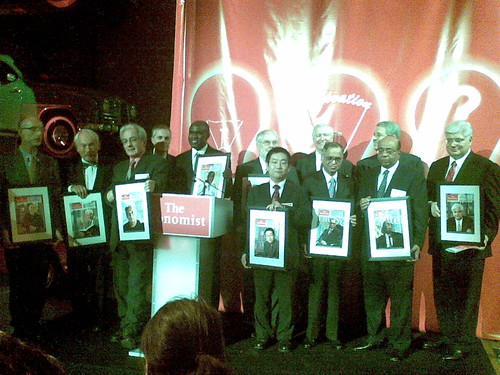
Fortunately for me, a perfect work storm hit him this week, and he had to grudgingly hand over to me his attendance at the tremendously interesting Economist 6th Annual Innovation Awards Ceremony and Summit. As a peon normally labouring several layers under the public radar screen, I normally just hawk my wares to an internal audience where I do only limited damage. Hence, when handed this opportunity I was a little nervous. The idea of sitting up on stage with bulging-brained business editor of the Economist, Tom Standage, the CTO of BT and a VP at P&G and talking to a press-strewn room of senior execs about Nokia's innovation story was a little disconcerting.
But actually things went rather well, I think, and my next blog post outlines roughly what I would have said, had I not been answering questions the whole time. But first, it's worth describing the context of this uniquely colourful and interesting meeting. The night before the Summit is an Awards Ceremony at the Science Museum. As a Speaker, I was invited, albeit last minute, and brought along my bemused friend Daryl (who I had planned to meet up with). He had great fun in trying to embarass me in this esteemed company, and fracture the delicate artiface of grownup professionalism that I wear rather awkwardly. However, as the champagne flowed, we started to get into our stride - we buttonholed famous Peruvian economist Hernando do Soto for 15 minutes. He's one of my heroes (I think I may have actually used that phrase to him) - his work on identifying the importance of property rights in developing countries has had a profound impact in his lifetime, and as such he now consults to 21 heads of State. His think tank is described by the Economist as one of the two most influetial in the world. We were seated at the table of Economist editor John Micklethwait, and inches away from the procession of Nobel laureats, billionaires and brainiacs that were honored in this year's awards. My shoulders were brushed by some pretty impressive midriffs: scientists who developed a way to do AIDS tests really quickly, the Chairman of India's outsourcing marvel Infosys, the founder and CEO of RIM (garage tinkerer to hero in 10 years); pioneers in LEDs; the guys who invented GMR (memory storage) which made my iPod possible, and finally an African telco entrepreneur who just sold his corruption-free business for $3.4bn. Phew.
At the end of last night it was obvious that I'd already had more than my money's worth and was starting to enjoy myself. The event was expertly managed, with delicious food, crisp timing, inspiring surroundings and ridiculously bright and successful people at every turn. Encouraging words from Tom Standage put me at my ease, and all I had to do now was think through what was the Nokia innovation story that I wanted to tell. I soon realized that actually, we've got a lot to say, the question was picking the right bits. Whether I did or not, you decide. That's the topic of the next post.
Wednesday, August 29, 2007
Pablos comes and stirs things up
"Pablos" is quite a well-known hacker, security expert and futurist, who I saw give a great presentation at the DLD Conference earlier this year, so invited him to come to Helsinki and talk to Nokia.
He's worked on numerous cool projects, such as OQO and the hackerbot - which drives up to people with open wifi and shows them their passwords. We had a roundtable brainstorming with him afterwords and my key takeaway was the many overlaps that exist between the murky world of hacking and the gleaming prize of innovation. As we start to launch our new internet services, we're going to need to learn how to be fuzzier, murkier and more willing to embrace the hacker ethos that Pablos and his uni-named friends embody.
Sunday, August 12, 2007
Enterprise2.0 - what does it mean for mobile?

In the past few weeks I’ve been having a number of interesting conversations about “Enterprise2.0”, what it means for mobility in general and for Nokia in particular. Despite a handful of productive and insightful commentators, it’s rather an anemic oeuvre compared to its Big Brother Web2.0 with very little written on the mobile aspects – as we could probably expect, given its U.S. origins. So, I’ve had some chats with some reliably smart folk such as Marc Orchant and Ajit Jaokar (who has also started musing on the topic), done some exhaustive research (yes, dear reader, minutes not seconds), and am liking what I see. It seems that many of the defining elements of Enterprise2.0 are a natural fit to the mobile space, in particular the possibility to capture and more easily transmit new kinds of data (for example putting location, context and communication history as an integral part of E2.0 services), the modular architecture of web syndication (RSS and user-defined filters work well on mobile) and, not least, the opportunities for the mobile to replace the PC, in particular for small businesses and / or emerging markets.
All is not rosy however. The mobile industry faces major obstacles in being part of this interesting arena, for example i) fragmented mobile operating systems, most of which are not built from the ground up to be web native ii) the default PC-centric approach towards enterprise2.0 applications (big screen, keyboard and sophisticated browser) and iii) despite some signs to the contrary, still slooooow progress by the mobile operators to get out of the way of innovation and introduce transparent pricing and proper flat-rate tariffs.
So I’d propose that the mobile industry should stop scrapping over who gets which share of an ever dwindling consumer pie and instead target the bigger prize – helping companies go 2.0. And that means a new, open and collaborative approach with a much wider range of partners than the mobile industry normally works with, so that we can figure out how to bake mobility into Enteprise 2.0 from the start.
Defining moments – people, not process
Definitions are often tricky, but in the case of Enterprise2.0, it shouldn't be hard - since it is really just Web2.0 goes corporate – from the frat-room to the boardroom. Harvard’s Andrew McAfee, one of those most active in the paternity battle for this new babe, defines it as “the use of emergent social software platforms within companies, or between companies and their partners or customers”. A more expansive view would also take in the people dimension, such as this summary from a recent Enterprise2.0 conference: "a radical change in the way businesses operate and is as much about the people, the culture and the processes as it is about the technology, tools and platforms.” So either way, this is a story of socializing the enterprise (not a word that comfortably fits in most capitalist dictionaries). But if this approach puts people front and centre in companies, rather than inflexible processs and acronyms, I’m all in favour.
McAfee provides a helpful acronmyn (SLATES) which highlights key 2.0 characteristics that will generally be found in these solutions: search, links, authoring, tags, extensions, signals. More explanations in his original paper. Social software is a key building block for Enterprise2.0, and it is starting to attract IT managers’ attention. Gartner’s July 2007 research paper, “The Emerging Enterprise Social Software Marketplace” predicts a compound annual revenue growth for social software of 41.7% through 2011 (from $120m last year to $700m in 2011). They say it’s now moving beyond the traditional blogs and wikis to include “social software platforms, bookmarking, communities of practice, discussion forums, expertise location and information feeds”.
The timing is right for this discussion, as Enteprise2.0 is rapidly going mainstream. McKinsey found three quarters of executives planning to increase investment on these kind of collaborative tools. A Forrester survey of 119 CIOs found 89% “had adopted at least one of six prominent Web 2.0 tools - blogs, wikis, podcasts, RSS, social networking, and content tagging - and a remarkable 35% said they were already using all six of the tools.”
So, to the mobile angle. Mobile has generally been the ugly duckling of the 2.0 world, but things are changing. Just when we were finally seeing mobile browsers tackle full Ajax-y web pages well and start to convince people thinking that the mobile web and the real web aren’t really that different, along came rich browsing applications that raised the bar still higher for our already fiendishly creative geeks. The Big Browser paradigm is inimical to mobile, and if we try and squeeze it into little screens it will end in tears. One example, while reading a NYTimes piece on how your friends can make you fat, I noticed that you’re able to double-click on any word in the story and pull up a definition of it, without that word being in hypertext. That is a fairly new concept to me, and if it becomes widely adopted, could pose yet another challenge for mobile, as today’s mobile browser user experience do not seem to allow such doubleclicks. However, we all know the world is going mobile. The interesting question is whether the mobile element will be an afterthought, tacked on with limited functionality, or will be a fundamental part of the experience from the beginning. So I looked back at the Web2.0 principles Tim O'Reilly wrote in 2005 that seem to have weathered the discussion well and have now become part of the furniture. Most of them as we can see are relevant to the enterprise space, but what do they mean for mobile?
1. The Web as a platform
On the consumer side, the Web is now clearly the global platform for developers, entrepreneurs and individuals. Consumer-focused startups now need a fraction of the money they used to in order to get up and running, and scale with relative ease. MySpace, Bebo and Facebook have brought social networking to the masses – people who neither know nor care that such a term exists. That this trend is going corporate is one of the tenets of Enterprise2.0. Consumerization of IT is afoot, and consumer-focused tools (IM, VOIP and social networks) are appearing either neat (19,337 Microsofties on Facebook) or diluted to taste (LinkedIn and other less colourful offerings). However, the fuzzy, beta-nature of many of these services mean they’re not suited for business critical functions such as the software that runs our big manufacturing plants. Also, it is still hard for web-based startups to break into the big corporate accounts – you can’t yet code a business lunch or round of golf in Ajax. Supporting this, the Forrester survey found that 71% of companies would prefer “tools to be offered by a major incumbent vendor like Microsoft or IBM [rather than] smaller specialist firms like Socialtext, NewsGator, MindTouch, and others”. So, the web is not yet as advanced for enterprise offerings as for the consumer side.
As for the mobile industry, let’s be honest – we still have a way to go. Fragmented operating systems, screen sizes, resolutions and capabilities frustrate development efforts, few entrepreneurs are making real money out of the mobile internet or seeing large scale service adoption, and few people would chose their operator (or handset maker? let’s see) to provide their social network rather than their fresh-faced, agile web innovator. However, let’s remember that the mobile is much more recent arrival than the PC, and there are uniquely challenging constraints regarding form factor, UI and battery life etc. It is worth mentioning here that Nokia has been focusing like a laser beam on this topic in recent months – it has dominated recent corporate strategy dicussions and is now at the core of our recent reorg and new company structure. Our CEO has made “we’re an internet company” pronouncements whenever he’s been offered a microphone; Symbian is taking great strides in becoming more developer and web-friendly, and our browser is one of the industry’s best kept secrets (and incidentally, shares most of its code with the iPhone). We’re also starting to deliver some rather funky new apps, including a mobile web server, real-world browsing and of course the web tablet and open-source Linux platform (Maemo). Advert over – but worth saying, and no doubt other mobile players are being active here. As an industry however, we’re still playing catchup.
2. Harnessing collective intelligence
Amazon is often held up as the first example of a service provider that lets users benefit from collective intelligence through their collaborative filtering engine. So, why would this not also work in areas other than books? For example, "intelligent" CRM software could scan the salesperson's customer responses, and suggests appropriate product offerings based on large numbers of other interactions, potentially also outside the company. (Actually, maybe it does already, it’s been a while since I worked in the industry). Most sales people are inherently mobile, and providing lightweight usable tools that expose this collective intelligence at the right time and in the right context, could be a very valuable offering to mobile users.
Wikis are great at capturing user-created intelligence and are rapidly becoming mainstream in the enterprise space, but if you’ve ever tried using one of today’s wikis from your mobile, you’ll appreciate the inherent problems here. Socialtext have been making moves in this regard, but here is a standard chicken-and-egg problem – limited demand resulting in limited development time, begetting limited offerings. UI and synchronization are the key issues to solve. As noted above, services requring smart and big browsers face an uphill struggle on the mobile. Today’s wikis often suggest side-by-side version control review, and require a big screen to see the differences. Synchronization is a key conceptual challenge with mobile, since they generally are not always on. Wikis rely on having one version of the truth – two people making changes to the same item when offline then syncing later makes would vex Schrödinger himself.
Today project managers in Nokia that I work with will generally just create an empty wiki space as they start a new project. This example is being played out across the corporate landscape, and could well disrupt collaboration applications that are built on the assumption that the designers – cut off from the action – know what’s right for each project. Here Nokia’s interests are well aligned with the wiki companies and web services companies in general – do away with the need for a PC and keep the smarts in the cloud. Once bottom up “architectures of participation” are in place, powerful learnings can then be harnessed - enterprise-focused social networking tools (Ryze, Tribe, LinkedIn) are able to unearth links, activities and dependencies around the organization which traditional hierarchies and organizational structures miss.
There are plenty of ways that mobiles could be used as both in-the-field data gatherers, providing relelvant context, or being the mobile manager’s tool of choice for viewing and interacting with the wisdom of the crowds who have gone before.
3. Data is the next Intel inside
A key element of anything with a 2.0–suffix is about shift of control and content creation to the edges. In most companies, ours included, there is a lot of valuable data being created by our employees and customers that is currently not captured or utilized. As the locus of value moves from product to service, capturing and understanding these conversations is becoming a key requirement. These customers and employees at the edge now have the tools, techniques and – significantly – expectations about their ability to make change happen. Wikis and blogs are now full-to-bursting with valuable first-person thoughts, reflections and data - some unstructured, others in an array of formats. This data is now the beating heart of today's enterprise, and often a unique repository of insights from the key experts in the company. Few senior managers will fully appreciate this resource because it has arrived via the back door.
Nokia's own efforts at promoting wikis and blogs internally continue and are now reaching mainstream. There is still however plenty more scope for their use in the harder-to-reach, business critical areas of the business, such as the sales teams and factory management. When you’re making 300m+ phones a year, the fuzziness inherent in wikis needs to be selectively applied. Also there is room for more innovation on top of the many tools that are available. TiddlyWiki (recently purchased by BT) integrates IP-communication plug-ins to the wiki framework, thereby allowing in-house IT executives to hack together innovative IP & mobile communication experiences, without needing long requirements lists, lead times, operator involvement or large amounts of money. They used to burn people at the stake for such heresy.
I expect to see companies doing more with wikis and blogs, using them for key product and customer data, with relevant user-level access controls if necessary. At Nokia we are using the open source MediaWiki engine used for a Nokia Infopedia, to make it easy for people to find and then use the key data about our products, solutions, organizational change initiatives, pricing, strategies, marketing initiatives etc. Often overlooked is the change of pace that needs to take place when the early adopter tools move mainstream - today's wikis are still too complicated and hard to use, so a top-down campaign to encourage wiki use will fail without adequate thought and resources being given to training and education, as well as experimenting with new simple UI developments such as drag and drop and other concepts that people are already familiar with. Salesforce.com's AppExchange and Jive Software's clearspace are interesting in this regard. We need to get the balance right between innovation and communication in order to bring all employees along this path.
Customer conversations that happen around our products represent the possibility to collect insanely valuable data, and engage in genuine conversations with the people who buy our stuff. Currently, as a product company, we don’t yet do this on a large scale – just a few pilot initiatives and ad hoc discussions around individuals’ blogs. Contrast this to Google - every second their search engine receives primary user data, about terms that matter to them, and the effect of every change that Google makes to its site can be callibrated immediately, and they can get a sense of the pulse of the world in real time.
Moving from the source of data to the type of data - we are going to be seeing next generation web services start to be built for a three dimensional world, and one in which context is king. This will massively increase the number and type of data-sources available as inputs in the creation of web services. The scope and type of services that can be built using this data are difficult to imagine, because so much of the web today is in two dimensions - when you are reading your email client, the email sevice provider does not know if you are in Sydney or Sidcup.
Data can be defined broadly here - from active, user generated tags (modular, and easy to submit, so perfect for mobiles) to specific data, captured in the background such as usage and communication metadata. How easy is it for users of our devices to access their own data - where they've been, who they've talked to, what applications they've used the most etc? In short, not easy at all, yet.
Nick Carr highlights a critical piece of the puzzle suggesting that Enterprise2.0 may have a better chance than other new fangled technologies – they make life easier not harder. In particular, the system gets smarter as people use it normally. “Knowledge is captured, in other words, as it's created, without requiring any additional work”. The classic consumer examples here are Last.fm’s music recognition and Amazon’s collaborative filtering – both services allow your profile to become smarter and more helpful to you over time, if you give it access to what you do. So the incentive to use it increases. A fascinating question to me is to what extent can relevant data be automatically captured from the mobile device that you carry with you 24hrs a day, and itself be an input to new Enterprise2.0 applications.
It is the different types of data available to creative entrepreneurs that should make the mobile industry sit up and take notice. Location information is one key ingredient that is trapped and lying dormant for want of a ha’penny of innovation. An entrepreneur I spoke to recently said he would have been charged €0.15 for each call that his application made to the operator to get a location fix from their cell ID. What a wasted opportunity to add value. He is obviously now routing round the roadblock and using GPS or consumer-created information database. Location is just one piece of data, but there are many others on the phone – which companies you call the most, who your friends are, who was in Bluetooth range over the past few days. With careful management and consumer-friendly usage, such data could lead to new technicolour applications and services that will make today’s Enterprise and Web2.0 services look black-and-white.
4. Perpetual beta
The mobile industry has unwittingly delivered plenty of betas in the past (WAP, MMS…), but they weren’t marketed as such. Instead of failures, they might have been seen as tentative first steps. But then it’d have been hard to justify charging consumers so much for them. Few in our industry seem to have recognized that the value of rich, direct feedback from users can far outweigh the minimal revenues that are captured by overpriced and underwhelming services. This requires a change in attitude, and a more open conversation with customers. This will in turn require changes in our transparency and "corporate voice". It is not about shipping and forgetting, but about partnering with customers who are trying to maximize the value of their investments. The Web2.0 software company 37signals does this well - a product-focused blog keeps news of almost-daily upgrades flowing and rapid and personal customer support for paying customers results in a high comfort level, and willingness to engage.
The beta mindset is coming to mobile: recent examples include Orange’s coding camp in August for developers in San Francisco (which perhaps included some marketing element to boost the launch of their Bubbletop web/widget service) and Vodafone R&D labs’ Betavine which aims to “encourage collaboration in the area of mobile and internet communications”. At Nokia, we’ve launched Nokia BetaLabs for the public and internally we have a service called AlphaLabs which now has about 75 applications and services for employees to test and provide feedback on. However, I see most of these activities as table stakes – we’re not really raising the bar of innovation beyond what is happening on the web, and in any event, it’s often far more challenging to be a beta tester on mobile – installation is harder (though our PC suite product is now actually pretty usable), user numbers are lower so there’s less feedback, and there’s always a danger that we’ll alienate (and bankrupt) our users who download data intensive applications without a decent data plan. Another challenge here is the current community forum experience on mobiles – it’s fairly poor, and most examples are just web-based forums squeezed to a small screen.
The more interesting issues relate to the topics that today’s beta aspects can’t handle well, and here mobile connectivity makes continuous feedback possible, and smart contextual awareness means that feedback can more easily be provided automatically. As mobile platforms mature and become more integrated with the web, expect to see greater use of the mobile as both a direct channel for feedback on mobile services, and a feedback tool integrated with existing web services (an example could be the integration of music recommendation service Last.fm with the music player on the phone).
5. Lightweight Programming Models
New open web standards are being deployed across the enteprise in particular to enable richer user experiences (e.g. AJAX), mashups (XML) and syndication of content (RSS). These allow individuals to create personalized feeds based on information that is important to them, but may not have a critical mass in terms of numbers of users, to get a tailored solution built for them. Related to this is the concept of "hackability" - how to make sure that the individuals (either employees or the customers-themselves) have enough control over the system to create their "own-label" solutions, and then, ideally share with others and improve for the benefit of the whole ecosystem. The concept of hackability is anathema to the mobile industry, and there are some pretty solid reasons for this: sensitive personal data and the ease of running up large bills being two obvious places to start. So clearly there needs to be some thought given to what is opened up and what is locked down. I’ve heard a number of people say that J2ME is not that interesting as you can’t do very much with it – such as accessing the calling and connectivity features. However, I’m a business guy not a technologist, so I can’t add much here, apart from to say that the mobile industry doesn’t have the luxury to sit on its hands and do nothing in this area, as our customers’ communication needs are increasingly being met by internet players who are embracing hackability.
One obvious example here are the core applications of the phone. How many fabulously interesting consumer and enterprise applications would be developed (within 24hrs) if web developers using lightweight protocols such as XML could easily gain access to the phone book’s contacts book, call log, message archive and calendar?
One test for lightweight programming models will be the extent to which "presence" becomes mainstream in corporate usage. Still the preserve of the young, IM-reared generation, and considered somewhat sceptically by incumbent executives, this is expected to become more mainstream. Alex Saunders has some good thinking around what he calls "new presence" with new value-enhaching applications such as call management, advertising, and enterprise solutions that are enabled by lightweight, interoperable web based standards such as XML. It is unlikely that the pace of innovation in this space will fit within the traditional top-down standards bodies processes; the mobile needs to allow innovators in to access the data and create new applications and services on top.
So, again, lots of potential IF the mobile industry embraces these lightweight models. In addition mobiles would work well with “loosely-coupled” services, such as mashups that tailor and filter data before it reaches you, helping you reduce information overload (one example would be an enterprise proximity social networking app that would display the current status of customers’ accounts that you are about to bump into at a conference). Maps mashup showing houses to rent within 500yards of where you are now). RSS is also well suited to mobile – not only does it deliver modular, packaged stories that work well on the small screen (or headset), but a feed reader or podcast client can load up a full days’ worth of content using free wifi.
6. Software above the level of the device
This issue shares many similarities with the “Web as a platform” principle, and if it is not handled well could represent a great sucking sound of value leaving mobile platforms. There is little point in having just a mobile platform – your services should be available on the mobile, just as they are on your colleague’s computer, or your car on the drive home. The mobile industry can no longer make phones that treat the web as a place to go, but needs to make devices that seamlessly extend the services available on the web, and provide the benefits of physical form.
Tim O'Reilly himself uses the example of the mobile industry’s biggest (unused) asset to date, the contacts book, to demonstrate how this will be affected:
"It's easy to see how Web 2.0 will also remake the address book. A Web 2.0-style address book would treat the local address book on the PC or phone merely as a cache of the contacts you've explicitly asked the system to remember. Meanwhile, a web-based synchronization agent, Gmail-style, would remember every message sent or received, every email address and every phone number used, and build social networking heuristics to decide which ones to offer up as alternatives when an answer wasn't found in the local cache. Lacking an answer there, the system would query the broader social network".
We cannot just decide not to lose control of the contacts book – again, we do not have the luxury of choice. We need to actively ensure that core functions have an internet strategy including but not limited to: have the web as a back up, channel for access and platform for innovation.
The calendar function is similarly powerful, and there seems to be an opportunity here for a really good cross-device core application suite - seamless syncing the user’s core information across multiple devices and platforms, with a core offering that lives in the cloud. Again we can turn to the web for lessons in innovation – Zyb, Soocial, Fidgt, Tabber, Anywr and of course Plaxo are doing fun things with contacts, 30boxes, and SyncMyCal making calendars work better, and RememberTheMilk and TaDa for task lists.
Apparently 93% of cameraphone photos never leave the phone – clearly because the software so far has not been above the level of a single device. This is changing too – companies such as Sharpcast and Shozu, and of course Nokia’s own Twango and Mosh, are intent on making it far easier to move media off the phone and on to the web.
In additon to core applications and one’s media taking to the cloud, the browser is also going agnostic and making the entire PC go virtual. Soonr allows you to access the contents of a remote PC from your mobile browser - something that shifts value away from the PC to the mobile. In the enterprise side, companies such as Zoho, DesktopTwo and ThinkFree are natural partners to mobile companies that seek to commoditize PCs – turning any of them into your own personal machine is true commoditization. So, again while it is still early days, the potential for mobile is strong – here we should aim to be a central part of an ecosystem in which intelligence lives in the cloud and uses the most appropriate device at the right time to allow the customer to intreract with the service.
7. Rich user experiences
Finally, the concept of user experience is key, and has been the driver of much of the shift towards consumer tools in the workplace. Compare the experience of using Skype with using our IBM-supplied IM Sametime-client and you see the point: one is fun, the other is grey. As Nokia we need to move beyond grey and give these tools a human face, this is perfectly consistent with our new tagline of creating “very human technology”.
The emerging "Millenials" generation (teenagers – 30yr olds) are looking to connect on a personal level with others, and more at ease with a meritocracy of ideas than a hierarchy of job titles. Creating visually appealling and accessible solutions (Second Life job interviews, Skyping the boss, AJAX interfaces on corporate websites) is going to be just another part of what it means to be Enterprise2.0.
What does this principle mean for mobile? Well, as processing speeds, screen resolutions and speaker qualities increase there is a natural tendency to make the phone sing, dance and perform to the nth degree. There’s certainly room for that in some consumer experiences, but when it comes to the enterprise space, a rich user experience gives me only what I want at the time I want it, and delivering this is the job of many of the principles above. Del.ico.us is a good example – almost everything on the page is there for a reason, and a click can filter and slice the data in intuitive ways. Efficient functions, no wasted space, no flashing gizmos – perhaps a good starting point for mobile service design?
Summary
Above I’ve reviewed O’Reilly’s original principles with my enterprise hat on, and with a mobile in my hand. It’s worth noting that these original principals were extended in a more indepth (commercial) report here, which gave a nod to Web2.0 poster child Chris Long Tail Anderson, and Dave Small Pieces Loosely Joined Weinberger. Dion Hinchcliffe notes that this report doesn’t change the substance of these principles, but does provide more context and affirms the link with Enterprise2.0 by providing more discussion of the enterprise impact.
Looking at it this way, the mobile seems to be an Enterprise2.0 story that is not often told, but one rich in potential. I’ve picked out a few potential implications for Nokia – and the mobile industry – that fall broadly into two categories - internally focused on improving our transparency, collaboration and speed, and externally focused, market orientated solutions, encompassing opportunities for both devices and services / solutions. I think this is a good time for us to take the initiative here - show the Internet incumbents (GYM) that we can match them at innovation, speed and customer-focus, and beat them solidly when it comes to helping companies adopting enterprise2.0 strategies that have mobile as a central element, not an afterthought.
_____________________________________
Some related resources:
Introductory slideshow to Enteprise2.0: http://www.slideshare.net/slgavin/meet-charlie-what-is-enterprise20
Andrew McAfee: http://blog.hbs.edu/faculty/amcafee/index.php/faculty_amcafee_v3/the_three_trends_underlying_enterprise_20/
Dion Hinchcliffe: http://blogs.zdnet.com/Hinchcliffe/
Mark Orchant: http://blogs.zdnet.com/Orchant/
Don Tapscott on Enterprise2.0: http://www.enterprise2conf.com/whitepapers/pdf/enterprise2conf-donald_tapscott.pdf
Ajit Jaokar: http://www.opengardensblog.futuretext.com/
Umair Haque: http://www.bubblegeneration.com/
Enterprise2.0 Conference, Boston, 18-21 June 2007 http://www.enterprise2conf.com/
- presentations here: http://www.enterprise2conf.com/2007/presentations/
Office2.0 Conference: 5 Sept 2007 http://o2con.com/index.jspa
Thursday, July 26, 2007
My MoSoSo preso
Just gave this presentation on mobile social networking to the Mobile Social Networking Conference here in San Francisco.
The deck lists 6 big ideas that I think will shape the space:
- Intimacy not irrelevance
- Push not pull
- Filters
- 3D not 2D
- Marketing not advertising
- P2P = Pocket to pocket
Sunday, July 22, 2007
Business Week on Nokia
A nice piece about Nokia in Biz Week:
[Nokia] seems to be doing everything right these days. Nokia's supply-chain management may be the best of any company in the world. It has a big head start in fast-growing markets such as China and India. And it has $9.5 billion in cash and practically no debt, so it can invest far more than rivals on developing new products or conquering new markets—and thus build even more intimidating economies of scale
The guys at HQ can savour this for approximately 2 seconds, and then get back to being paranoid. Things go down as well as up, and we're not likely to forget it. My $0.02:
- The story focuses only on the "phone as the product" market, and the 40% market share that we've been chasing for a decade (and seems to be tantalising close). But I wonder if when we reach it, the concept will be meaningless. What will the definition of a "phone" be in 2-3 years? Is it because one of the multiple wireless engines (wifi, bluetooth, wimax), happens to use government regulated cellular spectrum that it counts as a phone? Despite the current iPhone boost to the concept of a product business, in the long term, margins on all such products are declining, and the key test for our future competitiveness is the extent to which we can nail the services that build on top of, and extend, the devices.
- Let's bring some of that prodigous Indian innovation back to our markets. The pieces highlights a "$45 model [that] can go more than two weeks without a recharge and has a built-in flashlight" and "[a Nokia van that provides] instruction on how to use mobile phones. Two ideas we should implement in UK asap! :)
Wednesday, January 31, 2007
Well, I never. It looks like we may well be becoming an "Internet company" after all...
I've just returned from what what should have by rights been a tedious day, holed up in a subterranean convention bunker on the outskirts of a blizzard ensconced Helsinki, participating in a strategy meeting of our HR group. This kind of stuff, I thought to myself through gritted teeth, was what I get paid to do. Fair 'nuff.
However, after a 13 hour day brimming with powerpoints I've returned bounding with renewed energy for my job, and belief in this very Finnish, very unique company. The day was dominated by discussions around the transformation that our CEO has, with his characteristic bluntness put as "we're a mobility company, now we're also going to become an Internet company". (As to what this means exactly, for our purposes it is closely tied up with the shift to services, and in general, like porn, you know it when you see it.) The fact that Internet issues pervaded our discussions is no great surprise - what gave me the shot in the arm was the universally positive attitude in the room of appx. 100 people - almost by definition not the early technology adopters in the company - that major change was inevitable, we were going to deal with it like we had dealt with other major issues in the past, and we were going to do it damn well.
Letting go of control, embracing uncertainty, welcoming failure, sharing not hoarding, external openness, beta-level iteration, understanding and innovating together with end-users: these were all alien concepts to this company when I joined 3 years ago, and I felt out of place in an environment of highly skilled, disciplined, telecom enginneers, who designed complex solutions to complex problems. Before this gig, I had been coordinating trade policy networks in Brussels where the only way to get things done was informal collaboration, and I knew nothing of telco technologies (and, as a edge-ist didn't want to learn). Now, even in the 12 months that I've been working on these 2.0 and innovation related issues I've seen a major change of approach, both at the top and increasingly in the all-important middle layer. And today I felt on the same wavelength as most of the HR management, who have their tentacles in every nook of the company, and hold the levers to change that all important 'mindset'.
So, will it work? Who knows. It's certainly going to be a long journey as we start to roll out our consumer internet services and explore new business models and partnerships. However, the real sense I've got from today is that we're reached the crest of an uphill struggle for hearts and minds to focus on this issue, and the long winding road of Internet transformation is now looking that bit less daunting. Am looking forward to sharing more specifics as they emerge.

Tuesday, January 30, 2007
Future competitive advantage: Provenance?
Brad Burnham discusses the shift from hardware and services to data:

Later, it shifted to systems software, then applications software, and then networks. As more software functionality was delivered to a browser over the internet, the basis of competition shifted from features to service level metrics like reliability, accessibility and security. I believe that today, at least in the area of consumer web services, we have already moved on to a new focus of competitive differentiation based on data.
And then suggests that's not the end of the story, but the next elements "in the stack" could be governance, values and ethics. I like this approach, and would add one of my favourites to this pantheon: provenance. Provenance is about the place where things come from and the history and values associated with it. In answer to Brad's question, perhaps provenance is really the end of the line, since a company's history is pretty much impossible to commodify. How it uses its history as an asset is therefore up to them.
Oddly enough, on my first day at Nokia in November 2003 we had a brainstorming about future competitive advantages, and one of my suggestions was that in an era of commodification, the unique provenance of Finnishness could be an asset for Nokia. There is something unique about Finland's highly educated, disciplined workforce, the remarkable integrity and decency of its people, the bias to openness and transparency (if you see a car in the street you can find out the owner, address and how much tax they paid last year for the cost of a phone call), and the charming, empty, clean, open countryside. In a hectic world which in which the ultimate luxury is conversational currency and the ability to switch off, this could be rich seam. And in a world in which every technical innovation is replicated in the blink of an eye, this seems fairly defendable.


