Blimey, this is turning into being quite a tome. It looks like there's going to be two parts to this story - first, some of the key trends that set the context for the discussion, and second a selection of the innovation activities that we have been working on recently to ensure we accomodate these trends.
During the conference mentioned in the previous post I only got to talk to about a few of these ideas, but I wanted to document them while fresh. It's worth bearing in mind that everyone at Nokia will have a different take on this universally discussed, but rarely adequately defined theme of innovation - since there is an assumption that innovation is owned by everyone. In terms of what innovation is, this was a topic of the night before, and the Editor of the Economist's favourite definition, courtesy of Goldman Sachs, was "fresh thinking that creates value". That works for me, since it reminds us that new ideas alone are nice but irrelevant if they don't have an impact.
So, to the trends. As a company we are grounded in fundamental trends. Nokia is full of fact-loving engineers, and there needs to be data and evidence for what we do. We're unlikely to jump like a jitter bug to the latest shiny thing. That means that sometimes we may be seen as cautious, and may not get it right first time, but when we do it, we know we're doing it for the long haul. (N-Gage comes to mind). When I joined Nokia in 2003 in the delightfully named Insight & Foresight group, one of my tasks was to write the macro economic section of the annual Nokia WorldMap of the top trends in the converging digital industry. This was organized in terms of consumer, business, technology, macro trends, and some overall disruptions, and had about 50 trends that were the summary of a year's worth of analysis of the team. These are updated every year, and I picked a selection that I found most compelling to set the tone: the net generation, the search for authenticity, the information wake, harnessing collective intelligence, mass customization, consumerization of the enterprise (aka Enterprise2.0) and leapfrog innovation. So, now to provide more meat on the bones:
The demographic shadow of the baby boom generation is the net generation, today's 14-30 yr olds that are globally the most influential demographic, accounting for 25-40% of populations (highest in India and Pakistan) and something like 80% of consumer tech purchases, since they advise their parents (data from Don Tapscott's Net Generation project). They live in a polychromatic world (one of Joi Ito's favourite phrases) - vibrant, instant, colourful and multichannel, sharing their lives, often in breath-taking technicolour intimacy with the world, but more often just the people and communities who matter to them. These are people used to being exposed to 3000 brands a day, but not letting them stick. They filter out noise and froth, as if reared subconciously on the Cluetrain. They're the teflon generation, which drives traditional marketers crazy. They're used to being intimate with each other, and ironically, can also be intimate with brands, in particular those that demonstrate authenticity. Authenticity here can be defined as tranparency coupled with high performance, in areas such as environmental sustainability, provenance, employee relations and conversations, not marketing. It means cutting out the spin and the intermediaries between people and the things they want to connect to. Relationships - undiluted. Authenticity means people and companies articulate and share their own unique values, they don't just follow fads. And perhaps more than anything it means mountains of data. There is a high bandwidth for information, and the filters are expected to be client-side. The more blogs the better – not just from the CEO (unless he or she is interesting in their own right), but from the product managers who can talk with loving micro detail about obscure features. The data doesn’t need to be packaged – the rawer the better, otherwise it seems patronizing. Hence the carbon footprint of a packet of crisps – let the people decide. Data about the provenance of things and people is everywhere nowadays, and the smart companies are collecting and analysing it to create better services. Last.FM, Amazon and NefFlix filtering that learns your taste and suggests new things being a simple example. Up til now, these smart recommendation engines have been constrained by the paucity of useful, unique data sets that help the services know that your favourite thing and mine are one and the same. Similarly singers and their products, with the notable exception of a number of Stock, Aitken and Waterman clones from the 80s, are generally unique and different. Meaning can be layered on top, and smart algorithms do their bit. The most obvious (and bankable) recommendation engine to date is of course Google, that uses that wholly unique asset, the URL.
So, here I believe lies the potential of the mobile web – opening up new datasets for analysis and recommendation, with monetary values far in advance of the pennies that vendors pay for the click of a potentially interested surfer. If Amazon can use its smarts to get me to a buy a book based on my behaviour, why not allow someone to recommend what car I should be driving based on an analysis of my actual life, not just the slice of me inferred by my purchasing habits on one book-orientated website. The beauty of the mobile device is that it's not only smart, but connected. According to a China Mobile study, 91% of owners keep within 1 metre of them 24/7. Unlike traditional surfing through the web, this mobile device is moving with you through the "three dimensional" (i.e. real) world, leaving an information wake. The mobile device has the ability to capture and deliver a vast number of different data streams, such as location, who are your real friends (ie those people in your mobile phonebook, not the pale imitations found on social networking services), who do you call the most, and even in future, what you buy, what you eat or how you exercise. This data is created by the user and as such is – or should be - owned by them - getting them to part with it in order to receive useful and services is one of the primary innovation and creativity challenges of our generation. So far, I don’t see clarity in the industry on this and it’s dangerous. We allow Microsoft to create the tools that allow us to write novels, but do not expect them to claim ownership. Similarly, we hire the phone companies for the reason of connecting us with people we chose to connect to. If in doing that, we create a digital trail of commercial value, it would be folly not to assume that most of this value resides with its creator.
Smart companies will figure out how to get the customer to let them tap into these data streams, and use them to generate collective intelligence about what the customers want, often before they even know they want it. Automating data collection and feedback on products will be a breakthrough in terms of productivity, and here again the mobile has the potential to be part of this story. I often wonder why on earth the operators don't actually do something useful with their aggregate view of mobile users. How hard would it be to deliver very powerful real time traffic reports, just based on observing the anonymized progress of the swarms of phone-toting commuters?
Product innovation will be a lot easier when every product has an online service component providing usage information to improve the experience. Who would have expected that rowing machines - a product if ever there was one - would be turned into a social-networking compliant "rowing experience" by bundling net-connected service with the product, allowing you to race against other strangers and friends around the world. With products that can now talk back and among each other, it's a lot easier to have an aggregate view of what is actually happening around your customer's world, and how to fill the gaps. However, this is happening everywhere, with a surfeit of products and services clamouring for the every drop of customer attention.
The natural response to this is to dive into a niche, ever closer to the customer. And it is here that mass customization starts to become both necessary and ubiquitous. With the provision of a service layer on top, even the most anodyne, commodtized product can be differentiated. Telco companies have been trying for years to inject higher level valuable services over the creeping commoditization of connecting bits that is happening to their communications services. Whether its Nike's online service for creating a unique pair of shoes, or the 3D printer that can create a product while the customer waits, people are expecting their products in any colour they like, including black.
However, this supply chain flexibility does not come cheap, and will be another factor that puts pressure on profit margins, in addition to declining entry barriers and commoditization. As such corporate managers suffer quarterly performance anxiety, and face intense pressure to control every moving thing, and cut costs to the quick. Letting go of control and allowing innovation to meander throughout an organization, unencumbered by ROI concerns, must be very hard for people in this position. However, this is exactly what needs to happen in some cases, as in any event, corporates are losing control of their employees. Consumerization and Enterprise2.0 means, in short, Web2.0 principles and processes coming to the workplace, and the resultant empowerment of the edge (in this case employee rather than employer). Employers are learning they are often only coming second (or third or fourth) in the prioirity of their employees. No longer poorly designed collaboration, knowledge management and communication services stand up to scrutiny - employees now have more advanced collaboration technologies in their personal lives, and will expect to use them in the workplace.
Employers letting go of control of their employees is just one element of Enterprise2.0, the changing shape of the corporation being another. Why do we need marketing if a product sells itself and manages the customer support through its own Satisfaction-like community? The only interaction a customer may want with a company is to speak directly to the product manager themselves. As mobiles become more contextually keys for advertising, how will companies be able to accomodate the switch from mass, non specific advertising, to micro, personalized conversations with an audience of one. Finally, not only with corporate hierarchies change, but geographies too. Micro-multinationals mean that companies can locate anywhere, and take advantage of different cost structures and innovation clusters to become worldclass on a shoestring budget. In this vein, leapfrogging occurs - innovations happen first in the developing world as they are driven by creativity inducing constraints. Hence the best place to get cataracts done is in India, and most advanced mobile payments services in Africa.
So, here are a handful of the key trends that I feel are most important in shaping our competitive space - some more relevant than others, and some still debatable. Anyway, next post I'll take a look at some of our innovation activities that we've been putting in place to meet the challenges posed by these trends head on.
Friday, October 19, 2007
Nokia's innovation story, Part 1 - key trends


Economist Conferences: how they all should be
My colleague, fellow brit, sailing enthusiast and co-conspirator on some dangerously interesting ideas, John Clarke, is the CIO of Nokia. Unfortunately for him his role means he has real customers to keep happy, vendors to whip, and crises to solve.
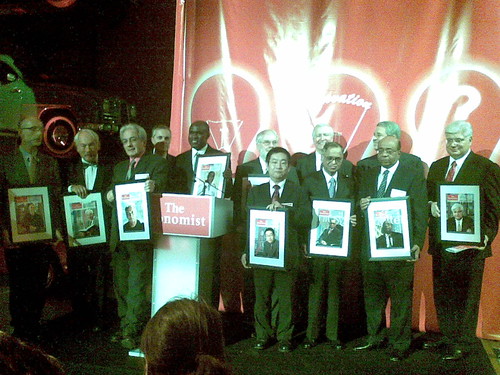
Fortunately for me, a perfect work storm hit him this week, and he had to grudgingly hand over to me his attendance at the tremendously interesting Economist 6th Annual Innovation Awards Ceremony and Summit. As a peon normally labouring several layers under the public radar screen, I normally just hawk my wares to an internal audience where I do only limited damage. Hence, when handed this opportunity I was a little nervous. The idea of sitting up on stage with bulging-brained business editor of the Economist, Tom Standage, the CTO of BT and a VP at P&G and talking to a press-strewn room of senior execs about Nokia's innovation story was a little disconcerting.
But actually things went rather well, I think, and my next blog post outlines roughly what I would have said, had I not been answering questions the whole time. But first, it's worth describing the context of this uniquely colourful and interesting meeting. The night before the Summit is an Awards Ceremony at the Science Museum. As a Speaker, I was invited, albeit last minute, and brought along my bemused friend Daryl (who I had planned to meet up with). He had great fun in trying to embarass me in this esteemed company, and fracture the delicate artiface of grownup professionalism that I wear rather awkwardly. However, as the champagne flowed, we started to get into our stride - we buttonholed famous Peruvian economist Hernando do Soto for 15 minutes. He's one of my heroes (I think I may have actually used that phrase to him) - his work on identifying the importance of property rights in developing countries has had a profound impact in his lifetime, and as such he now consults to 21 heads of State. His think tank is described by the Economist as one of the two most influetial in the world. We were seated at the table of Economist editor John Micklethwait, and inches away from the procession of Nobel laureats, billionaires and brainiacs that were honored in this year's awards. My shoulders were brushed by some pretty impressive midriffs: scientists who developed a way to do AIDS tests really quickly, the Chairman of India's outsourcing marvel Infosys, the founder and CEO of RIM (garage tinkerer to hero in 10 years); pioneers in LEDs; the guys who invented GMR (memory storage) which made my iPod possible, and finally an African telco entrepreneur who just sold his corruption-free business for $3.4bn. Phew.
At the end of last night it was obvious that I'd already had more than my money's worth and was starting to enjoy myself. The event was expertly managed, with delicious food, crisp timing, inspiring surroundings and ridiculously bright and successful people at every turn. Encouraging words from Tom Standage put me at my ease, and all I had to do now was think through what was the Nokia innovation story that I wanted to tell. I soon realized that actually, we've got a lot to say, the question was picking the right bits. Whether I did or not, you decide. That's the topic of the next post.
Wednesday, August 29, 2007
Pablos comes and stirs things up
"Pablos" is quite a well-known hacker, security expert and futurist, who I saw give a great presentation at the DLD Conference earlier this year, so invited him to come to Helsinki and talk to Nokia.
He's worked on numerous cool projects, such as OQO and the hackerbot - which drives up to people with open wifi and shows them their passwords. We had a roundtable brainstorming with him afterwords and my key takeaway was the many overlaps that exist between the murky world of hacking and the gleaming prize of innovation. As we start to launch our new internet services, we're going to need to learn how to be fuzzier, murkier and more willing to embrace the hacker ethos that Pablos and his uni-named friends embody.
Tuesday, April 10, 2007
From advertising to a direct dialogue with customers. Are you ready?

This note is aimed at brand owners, frustrated by the increasingly expensive and ineffectual advertising spending on traditional media and wondering how best they can get their message out. It suggests that today's disrupted media business is too frail to support the demands of brands wanting to advertise. This is no bad thing in itself because the advertising business itself is bloated, inefficient and outdated, and companies would be better off figuring out how to interact with and delight their current customers, rather than wasting money on trying to reach and influence non-customers.
Advertising heal thyself
Today’s advertising business is suffering from (at least) two major flaws. The first is the industry that the traditional media business can no longer offer an economically viable channel to allow brands to deliver their messages to a sizable captive audience. The second - bigger - challenge is that the concept of advertising is becoming less relevant in today's flat-earth world.
Challenge one: the advertising industry is overly reliant on a lame and enfeebled media business
The “traditional” media industry is fragmented, broken, confused and failing to deliver on one of its major tasks - to help brands reach people. (If you don't agree with this, read Bob Garfield's Chaos Scenario before reading on.) The media machine that is pulling the advertising load is to put it bluntly, knackered. Reaching non-customers is getting harder due to a proliferation of alternative media channels and consumer-side filters. Cheap tools and the Web as a distribution platform for connecting people allows anyone to be a broadcaster (or podcaster) resulting in massive fragmentation. Reaching 80% of US TV viewers used to require placing adverts on just four shows in the 1960s, today it would take over 100. Those who are 'formerly known as consumers' employ both hardware (e.g. DVR) and software (e.g. RSS) filters to give them control. Forrester says that 92% of people skip ads on DVRs, and half of US households are expected to have them by 2010. Ironically, brands have until recently been forced into paying ever more for in "upfront" fees for broadcast slots on US TV networks, simply because there was no other place for them to put their money. No wonder P&G's Jim Stengell says, "I truly believe, and I know many of you do, that today's marketing model is broken."
Further complicating the picture is the reality of “media multitasking” – no more the whole family sitting rapt around a television set or radio – today’s audience (kids in particular) will be IM-ing and gaming at the same time as watching TV and listening to the radio or podcasts. This plays havoc with those already creaky viewer figures. The result of this is that some brands are getting desperate, and “outsourcing” their brand to celebrities of various ilks, but these can be crushingly expensive and more importantly, unpredictable and prone to embarrassing PR gaffes.
Beware the siren calls of the search engines
So if traditional media is broken, how about the new media experience? Internet advertising is growing rapidly as advertisers move their money towards where people are spending their time. UK ad spending – up 40% year on year, now accounts for 10% of total advertising spend, and is typical of the trends here. Several flagship advertisers are now massively increasingly their online spending this year and scaling back TV spend. And happily for the brands looking for simplicity, Google, Yahoo and Microsoft account for a lot of the internet traffic, and claim the vast majority (appx 80%) of online ad spending.
So surely search engine marketing provides salvation for brands fed up with the old media offerings? Well, not really for a number of reasons. First, there's a long way to go before the demographics overlap - PC penetration is not TV penetration, in particular in the key markets of China and India. Second, the model itself has flaws – industry experts suggest that click fraud can account for up to 30% of revenues. Third, bidding on competitors’ keywords is now rampant and resulting in spiralling costs (though this practice is probably one class-action suit away from being history). And fourth, just when brands had been extracting themselves from a reliance on an expensive media middleman, the emergence of search engine as intermediary will cost them dear. Overall however, is the issue that search engines are still intended to deliver advertising messages to non-customers and attract them to become customers. Here’s the second major flaw in the advertising industry's model:
Challenge two: advertising itself is an increasingly outmoded concept
The second major challenge facing the industry is that advertising itself is an increasingly outdated concept in today’s transparent and connected marketplace. Influencing prospective customers is ever harder; people are increasingly immune and sceptical to the battering of thousands of commercial messages. Typical of the ennui in the market, the ad agency WPP found that nearly a quarter of US ‘baby-boomers’ are insulted by the advertising messages that companies are sending them. The emerging Generation C reject marketing gimmicks (and can smell astroturfing a mile away). They make purchase decisions based on their trusted advisors and require transparency from the companies they deal with. People it seems, now generally prefer word of mouth to word of the Man.
Consider how Barrons defines advertising: a “paid form of a nonpersonal message communicated through the various media by industry, business firms, nonprofit organizations, or individuals.” These concepts seem outdated – advertising, we are told, should be about a bunch of things which the web is making redundant: in particular paying intermediaries a lot of money for the job that you could be doing better yourself. The new opportunities of free, personalized two-way communication delivered directly to users sounds more like blogs and community forums. As Bob Garfield points out, the head marketer at P&G puts it like this: "What we really need is a mind-set shift, a mind-set shift that will make us relevant to today's consumers, a mind-set shift from 'telling and selling' to building relationships."
Forget non-customers – turn existing customers into your new sales force
So with the advertising channel broken, and the approach itself increasingly irrelevant, where next for brands trying to get the message out about their products? At issue is the need to refocus attention from advertising to non-customers to serving current customers better. Sounds obvious? If so, why aren’t more companies doing it? Making great products, informing, interacting with and delighting their existing customers, rather than prospecting for hard to reach non-customers should be the new priorities. In an increasingly confused consumer maelstrom, advertising to people who are not your customer still serves some purposes – brand recognition, credibility (wow, that startup can afford a SuperBowl ad!?) and general feel good.
Fine, but when it comes to shifting products off the shelves, getting product feedback and innovation suggestions, the relationship of business value to customer intimacy is I would propose, strongly positive, something like this:
The key here is how to meet the needs of a more engaged customer base without incurring massive costs or raising expectations. Creating and fostering an open dialogue with customers is a daunting but necessary exercise. This is one of my pet topics, and there's not enough room to expand at length here, but at a high level, I'd suggest the following elements to achieve this within a reasonable time and cost scale (presuming that you've already got a great product to get excited about):
- Make every employee an ambassador. This requires creating a mindset within the company that emphasizes openness, collaboration, speed and employee problem-ownership (presuming they're the relevant experts). It's also about installing tools such as wikis (shameless plug...) so that individuals not only feel empowered but are empowered to collaborate with others and take the initiative themseles. All the better for reacting when you...
- Engage in direct dialogue with customers. Interacting with customers directly, for example allowing them to subscribe to web-based feeds of product news and releases. The use of syndication (RSS, Atom etc) makes dialogue an asynchronous and therefore more manageable process - this is not about giving the CEO's mobile number out to every customer. Well managed, honest external blogs are useful tools for smooth information dissemination that arguably fulfills the role of what advertising used to do. An even easier way to foster dialogue is then to...
- Facilitate customer-to-customer dialogue. Forums and chat rooms are great examples here - apparently over 30% of HP Europe's customer queries are answered by the Q&A from message boards. Being a fly on the wall to these discussions is important, even if they're not on your own sites - tools such as technorati allow Dell to search for phrases such as Dell Hell on blogs and join the discussion if necessary.
These activities are now pretty much table stakes in the move from being a company that just doesn't get it to one engaged and benefitting from a richer dialogue with current customers. Of course, there will always be room for some old world advertising - somebody has to spend the expense accounts after all. But it may be a worthwhile exercise to look at your company and ask where along the scale between "advertising to non-customers" or "conversations with current customers" they're sitting, and whether they're moving in the right direction.
The final point, which takes us beyond table stakes and into the realms of the Truly Interesting, relates to the eventual primacy of the mobile rather than the PC as the way to interact with the web. I would dearly like to see a new mobile marketing paradigm that allows the mobile to be the platform to allow companies to carry out ongoing conversations with their customers. Mobile devices are the natural interfaces for receiving filtered and tailored customized subscription information from companies that interest then. Note, this is not advertising as we currently understand it; it does not involve any use of the hackneyed “30 cents off a Starbucks” cliché. And it certainly is not about unsolicited spam. It would be a foolish company that abuses extraordinarily intimate relationship that the mobile device can deliver.
No, this is marketing, or more accurately – business as usual. We used to talk about ‘Internet companies’ – but that now seems quaint, as we recognize that the Internet is embedded into every facet of a company’s operations and their customers similarly expect to use the web to carry on conversations with the company. I’m looking forward to a time when brands are able to dramatically improve the quality of service they deliver to their customers rather than wasting money on inefficient advertising campaigns, and they incidentally will use an internet-enabled mobile device as the mechanism for this.
So, in summary, the media business is in turmoil, but the future for brands is not to simply take their old advertising approach over to the Internet. Instead, the smart companies will recognize the need to shift their focus from non customers to current customers, and harness the power of the Web to deliver a personalized, direct interactive dialogue with customers, and then to start thinking about what that personalized, intimate experience would look like on the mobile platform.


