I want to build a tool that allows spittle-fuelled invectives, deep dark howling rants and purple prose that takes your breath away. But relax, this isn't a story of bad hatred - of people, politics or puppies. No this is about good hate. Good hate is hatred of bad things. Crime, corruption, inefficiency, lawlessness, thuggery, treachoury, cantankerousness and deeply bad service.
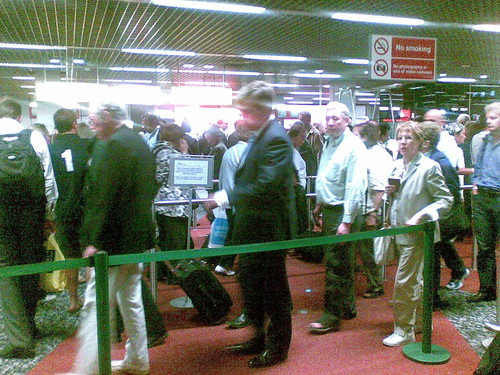
What started this train of thought was a specific incident last week as I ate the gruel of tatty "service" that the beleaguered Heathrow airport serves up cold. Arriving late night in Terminal 4, there was a long queue of several hundred people waiting for passport control, and a separate queue for the iris scanning machine. Now, having had my iris scanned I went up to this shorter line, pleased with the prospect of a sharp exit. After about 5 minutes of waiting around and realizing that the line wasn't getting any shorter, it was clear that the system wasn't letting people through. An official overseeing the mess from the command center then saunters up and says, Nope, the machine's not working, so we'd better go back to the line. By this time, a few other hundred people have arrived, so we stumble back, with more of our lives wasted. So bad enough that the machine wasn't working (happens on about 1 out of 3 times I've tried these machines) but nobody could be bothered to even put up a sign saying sorry, don't waste your time. Just one example, there are countless more, at that airport alone.
My annoyance at the appalling state of our airport is mashed with embarrassment that any foreigners should be exposed to this as the first thing they see, liberally sprinkled with utter helplessness - both due to not being able to do anything about it but also because of my inability to vent my frustration in a satisfactory way. Of course there was huffing and puffing by my co-victims in the queue but we're all in the same boat.
I should shrug it off, toughen up. God knows, as a Londoner I have ample opportunity to feel frustrated with what goes by the name of our public transport service. I felt like jumping up and down and screaming NO, THIS IS COMPLETELY SHIT!! However it's been about 30 years since my last public tantrum, and civil society impedes a direct 1-1 relationship between the rages in my head and my vocal chords.
But, let's leave aside this dark story - the reverse, happier side is also true. I also want to create a tool for Love. Heaping large amounts of love on a person should be easier than it is today. I want to say that I love that building, that organization, that hero that I've never met.
And to an extent the Web does give me a voice to do exactly that. However, it is not really well designed to deal with real things - it prefers to deal with URLs. It organizes by [http followed by indecipherable code] rather than [that which we commonly refer to as...]. Having a naming convention built around real things and real places would be really helpful. Where do I go if I want to complain about Heathrow? Well, if I wanted to complain about a restaurant inside Heathrow I might be lucky, and find something on Yell or Timeout or Squaremeal or LondonEating or wherever. But what about Heathrow itself? This creaky, wheezing behemoth is a major part of our lives, but its online presence is an anodyne, sterilized boilerplate, which clearly has no intention to allow us to peak behind the curtain to the conversations that real people are having with each other about this infernal place, and attempting to have with Heathrow.
What I think we need is a place on the web that can be the hub of discussions around an airport, a brand, a government, a city, a product or, well, just about anything, whether or not the owner in charge likes the idea. Of course these conversations are happening in a fragmented way today, and Google is doing a good job at knitting these together for those who search for them, but this is ad hoc. Each of us enter queries differently, and the results that Google delivers are generally between them and us, with few search terms on brand names delivering the genuine voice of the people rather than the PR department. However, there's no denying - it would be nice to have a global directory of things that we all use and refer to.
Happily, am seeing some small steps in this direction. People-powered customer service directories is not something I knew existed until recently, and now there are two. The founders of Silicon Valley startup Satisfaction were over in London last week to speak at the Future of Web Apps conference, and I've just heard about another startup from South Africa called HelloPeter, which has been doing the same kind of thing for a while. I had a good chat with one of the founders of Satisfaction, Lane Becker, who was also one of the founders of the rather wonderful Adaptive Path. I was struck with the simple proposition of their site - they're going to help your customers have conversations about your brands, so you might as well join in. This level of transparency requires a company to feel good about their product, and their customers, and some impressive, customer-focused companies such as Timbuk2 are already using it to have even more open conversations with their customers.
Well, you can guess the rest. Reared on a Hollywood addiction to happy endings, I'm hoping that need for hate will disappear. So I created a channel for Heathrow at Satisfaction (http://getsatisfaction.com/heathrow) noted my problem, and now wait, patiently and ever optimistic (like those in the line for passport control) that Heathrow - and bad services around the world - will start to listen. And maybe even respond.
Saturday, October 06, 2007
I want to build a tool for hate


Tuesday, June 19, 2007
On stigmergy, ants and VRM
Joe Andrieu writes a savvy post on the VRM concept. My brain is tired from doing the requisite backflips, but happy for the workout. He relates vendor management to one of the "you know it's important but how" concepts - swarm intelligence.
This suggests that it may be easier to rearchitect supporting business systems around the user, just as we know we need to do for the consumer experiences themselves. Here the user is the local store of intelligence which vendors (and whomever else) can then interract with, and in so doing improve that user's intelligence. So, if we can get systems to learn that everytime the individual gets on a plane he takes the window seat, maybe we can infer something useful that we can use for picking seats on other modes of transport. Or maybe not - but it'd be fun to have the data to play with.
This is a natural extension for mobiles, and one that may be a counter signal to the "data is always and everywhere in the cloud" schtick. Guess what, sometimes the data can be local too.
"instead of a bunch of individuals running around leaving a disparate data trail which is hard to keep track of, the individual represents the digital environment where data is stored by vendors. When the next vendor comes along, the data is there, available for use, without the need for complex integration, processing, or systems maintenance, just like the environment is there for the next ant to come along, allowing that ant to do what they do without a complicated brain or sophisticated map of the territory.
It doesn’t matter that Doc was physically moving around in his example. From Doc’s perspective, he was always right there. “No matter where I go… there I am.” This is more than just a solipsistic view of the universe, it is perhaps the most critical insight of the VRM user-centric gestalt. When you put the user at the center, it makes it trivially easy to manage and integrate the entire digital experience of the user. Because it is all right there, all the time.
Two obvious messages here. First, we all need to do a helluva good job in getting vendors in many different industries and sectors to agree on protocols that speak consistently to their customers. And second, this is very much about the mobile industry - and we all know how good our industry is at quickly agreeing global standards. The upside here as far as I see it, is that this is more of a device story than a network story, so may be a little easier. Anyway, fun times ahead.


